← All skills

Skill

Performance profiling

Measuring where a program spends its time and memory. A Valgrind trace showed nearly 89% of Achilles's data accesses are whole 8-lane vector loads and stores.

2 log entries1 project

AchillesBest example

SIMD: eight robots per instruction

Pull request

Also shows: Performance & SIMDC++

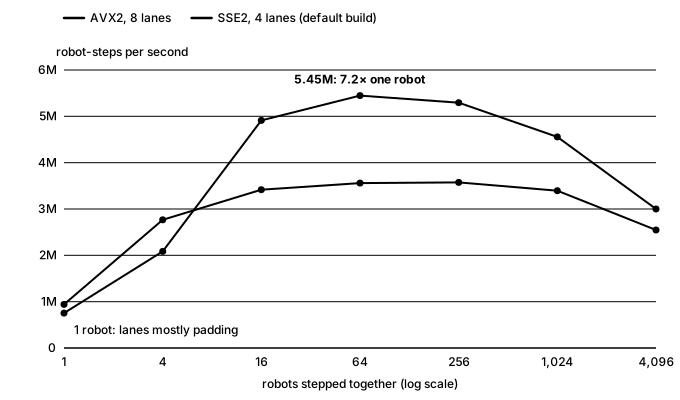
V3 replaces V2's Eigen with my own spatial algebra on xsimd, and stores every field as a structure of arrays: each component of each field, say the x angular velocity of every joint, is its own contiguous, aligned array. Joints are sorted by their depth in the tree, and each group of SIMD lanes holds joints at the same depth. With many copies of one robot, that puts the same joint of different robots side by side, so one instruction can load, update or store a quantity for eight robots at once (eight lanes with AVX2, four in the default SSE2 build). A Valgrind trace of the compiled binary confirms it: 88.9% of all accesses to simulation data are whole, aligned 8-lane vector loads or stores. The payoff is that filling the lanes is nearly free. On a seven-link arm, one robot takes 3.1 µs per step, while eight robots in the 8-lane build take 4.3 µs, 5.7× the robot-steps per second.
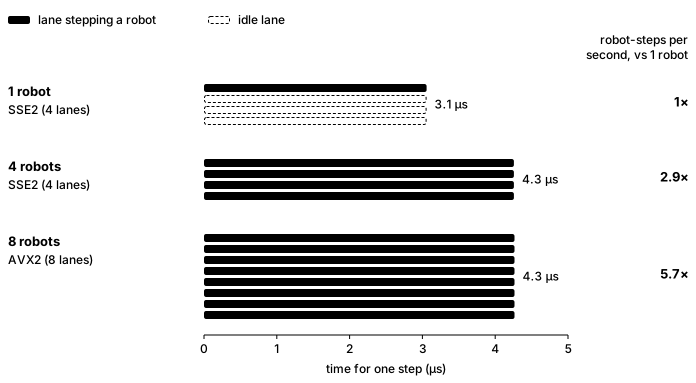
Three bars of SIMD lanes showing the time for one step of a seven-link arm: one robot in the 4-lane build takes 3.1 microseconds with three lanes idle; four robots fill the lanes in 4.3 microseconds, 2.9 times the robot-steps per second; eight robots in the 8-lane AVX2 build take 4.3 microseconds, 5.7 times
One step of a seven-link arm on one CPU core, best of 18 runs. Batched runs also step one shared fixed root.
Line chart of robot-steps per second against robots stepped together, seven-link arm. With one robot, 8-lane AVX2 does 0.75 million and 4-lane SSE 0.94 million. AVX2 climbs to 5.45 million at 64 robots, 7.2 times its one-robot rate; SSE levels off near 3.6 million.
The same effect across batch sizes: throughput climbs until the lanes are full.

Achilles

Beating MuJoCo on throughput

Benchmark code

Also shows: Simulation (MuJoCo)Performance & SIMDC++

To see where V3 stood, I benchmarked it against MuJoCo 3.15 on the same arm scenes, converted from the same .arow files, at the same 2 ms step, single-threaded on my laptop (Intel Core Ultra 9 285H). Batched across SIMD lanes, Achilles steps a seven-link arm 3.3× faster than MuJoCo's best single-threaded mode, reaching 5.45 million robot-steps per second at 64 robots. In double precision, MuJoCo's own, Achilles is still 1.5–1.6× faster at most batch sizes, and its results match MuJoCo's to about one part in 10¹¹. The one loss is a single seven-link arm, where most SIMD lanes sit empty (0.97×).

Line chart of speed relative to MuJoCo by number of links. V2 with one robot falls from 1.1× at one link to 0.48× at eight. V3 with one robot is 2.8×, 2.1×, 1.6× and 0.97× at one, two, three and seven links. V3 with 64 robots batched is 2.7×, 2.6×, 3.0× and 3.3×.
Each version timed against MuJoCo on the same machine, in its own benchmark: V2 against MuJoCo 3.3 (no gravity, 1 ms step), V3 against MuJoCo 3.15 (2 ms step).
The same double pendulum in Achilles and MuJoCo, matching out to 8 seconds. Same scene and start, both RK4 at a 2 ms step.