← All skills

Skill

Numerical integration

Stepping a simulation forward in time without it drifting. Semi-implicit Euler, velocity Verlet and implicit midpoint in Achilles, compared on energy.

2 log entries1 project

AchillesBest example

Integrators that hold energy

Commit

Also shows: Kinematics & DynamicsC++

With the accelerations right, longer runs exposed the next problem: semi-implicit Euler drifts. A frictionless double pendulum should conserve energy, yet over 10 seconds at a 2 ms step Euler's total energy wanders by up to 0.56 J. Euler updates the velocity from the current acceleration, then moves the position with that new velocity, which is simple but only first-order accurate. Velocity Verlet splits the velocity update into two half-steps around the position update and recomputes the accelerations in between, halving the drift to 0.28 J. Its weakness is that velocity-dependent forces like Coriolis are evaluated at an estimated velocity. Implicit midpoint evaluates the dynamics at the average of the old and new states, making each step time-symmetric. Because the new state isn't known in advance, it iterates four times to converge, and it stays within 0.0006 J. RK4 instead samples the dynamics four times across the step and blends the results, reaching fourth-order accuracy and staying within 0.0001 J.
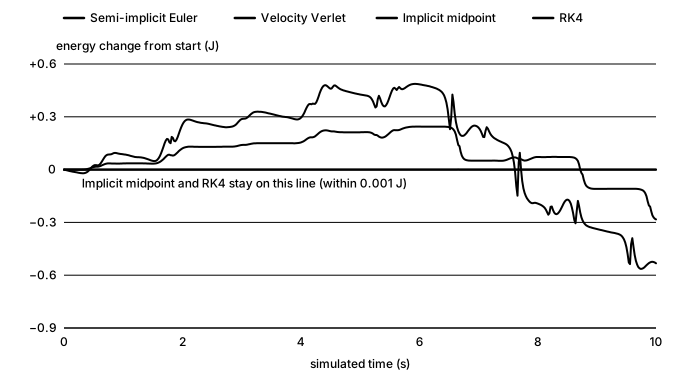
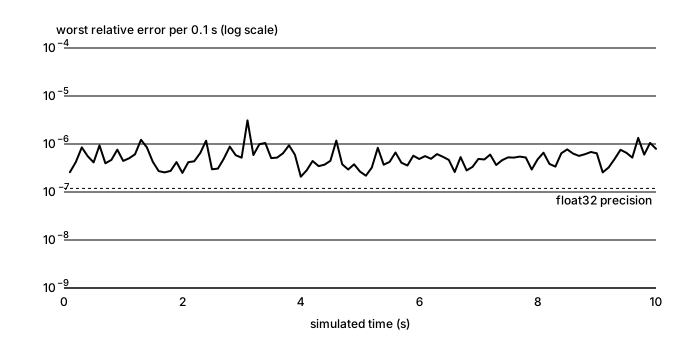
Chart of the change in total energy over 10 seconds for four integrators: semi-implicit Euler wanders between about −0.56 and +0.49 joules, velocity Verlet between about −0.28 and +0.24, and implicit midpoint and RK4 stay flat on the zero line
Energy should stay constant. Double pendulum released from horizontal, 2 ms step.

Achilles

Dynamics: the Articulated Body Algorithm

Pull request

Also shows: Kinematics & DynamicsC++Simulation (MuJoCo)

V2's dynamics were wrong in ways only a reference could show: brought back to life next to MuJoCo, a one-link arm swung exactly 4× too fast (it used the free-body inverse inertia, dropping the parallel-axis term), and a two-link arm moved in the wrong shape. V3 runs the full Articulated Body Algorithm, with Coriolis and centrifugal bias terms, parent-to-body transforms and gravity as a fictitious base acceleration, and steps it forward with semi-implicit Euler, the same default MuJoCo uses. Here all three drive the same arm with the same shoulder torque and no gravity, since V2 never had any. V3 stays within 3×10⁻⁵ rad of MuJoCo for all 4 seconds, while V2 has swung the shoulder 4.5 times as far and folded the elbow forward instead of letting it trail behind.

The demo arm with a constant 0.1 N·m on the shoulder, none on the elbow and no gravity, semi-implicit Euler at 1 ms. All three are drawn by MuJoCo's renderer, since V2 never had one; the yellow trail is the forearm tip's last second.

MuJoCo is only a reference, so I also checked V3 against an exact answer. A double pendulum is chaotic and has no closed-form trajectory: two simulations that differ by a single rounding error eventually go completely different ways. Its equations of motion do have a closed form, though. Lagrangian mechanics reduces them to a 2×2 linear system that gives the exact joint accelerations at any given position and velocity. I derived that system independently of the engine's code, then compared it with V3's accelerations at every state of a 10-second run. Because each state is checked on its own, errors can't build up and chaos can't amplify them. The two agree to within 3×10⁻⁶, which is float32 round-off, and V3 matches MuJoCo to the same 3×10⁻⁶.

Log-scale chart over 10 seconds of a double pendulum: the worst relative error in Achilles' joint accelerations against the closed-form solution stays between about 2e-7 and 3e-6, just above the float32 precision line, with no growth over time
ABA against the closed-form solution at every state of a 10-second double-pendulum run.