AchillesBest example
Dynamics: the Articulated Body Algorithm
- Code I wrote
- 4,217 lines
- Language
- C++20
- Tools
- MuJoCo
- Hardware
- Laptop
- Role
- Solo
- Status
- In main
Also shows: C++Simulation (MuJoCo)
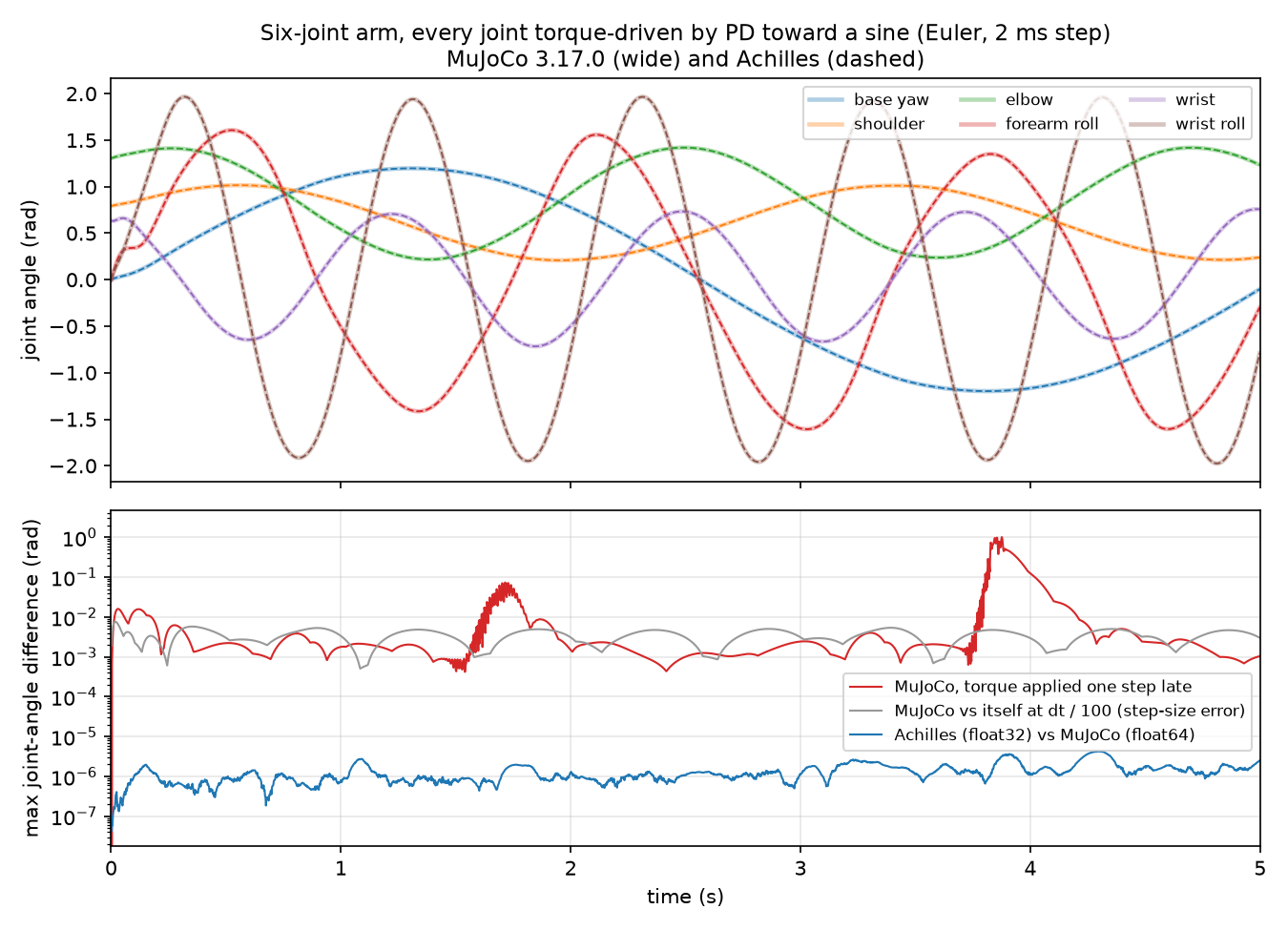
V2's dynamics were wrong in ways only a reference could show: brought back to life next to MuJoCo, a one-link arm swung exactly 4× too fast (it used the free-body inverse inertia, dropping the parallel-axis term), and a two-link arm moved in the wrong shape. V3 runs the full Articulated Body Algorithm, with Coriolis and centrifugal bias terms, parent-to-body transforms and gravity as a fictitious base acceleration, and steps it forward with semi-implicit Euler, the same default MuJoCo uses. Here all three drive the same arm with the same shoulder torque and no gravity, since V2 never had any. V3 stays within 3×10⁻⁵ rad of MuJoCo for all 4 seconds, while V2 has swung the shoulder 4.5 times as far and folded the elbow forward instead of letting it trail behind.
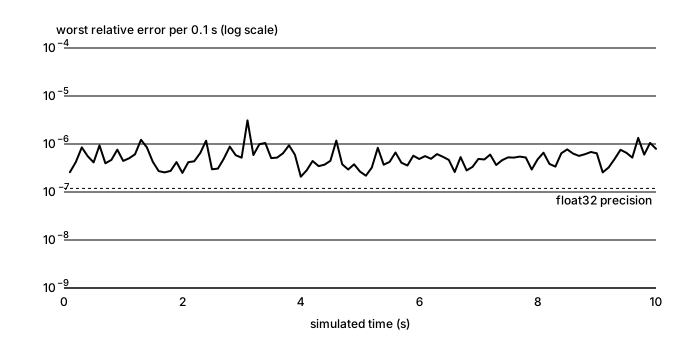
MuJoCo is only a reference, so I also checked V3 against an exact answer. A double pendulum is chaotic and has no closed-form trajectory: two simulations that differ by a single rounding error eventually go completely different ways. Its equations of motion do have a closed form, though. Lagrangian mechanics reduces them to a 2×2 linear system that gives the exact joint accelerations at any given position and velocity. I derived that system independently of the engine's code, then compared it with V3's accelerations at every state of a 10-second run. Because each state is checked on its own, errors can't build up and chaos can't amplify them. The two agree to within 3×10⁻⁶, which is float32 round-off, and V3 matches MuJoCo to the same 3×10⁻⁶.