← All skills

Skill

Technical writing

Explaining technical work clearly. I wrote the ARCHITECT paper's VLA failure analysis, and design documents like Achilles V3's.

2 log entries2 projects

Benchmarking VLAs for ARCHITECTBest example

The paper: A Few Words Go a Long Way

PaperWebsite

Also shows: Robot learning

ARCHITECT is the lab's system, not mine: I'm a co-author for the VLA benchmark behind its comparison. The paper asks whether robot programs written by a coding agent, and fixed with a few words from a person, can beat end-to-end VLAs. ARCHITECT has an LLM write a program from perception and control tools, runs it, and reads back an execution trace. When it fails, a person says what went wrong ("grasp the cup from the top"), and the fix is saved to a skill library the agent reuses on later tasks.

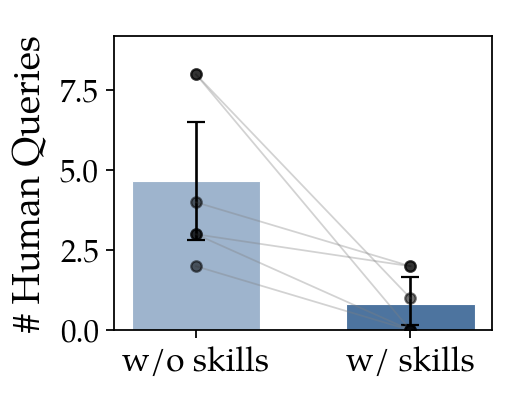
On eight real tasks on a Franka Panda, ARCHITECT succeeded 70 to 100% of the time on every one, while Code as Policies, which writes the program once, topped out at 60%. The VLAs held their own only on simple pick and place, where π0.5 succeeded 90% of the time on the banana and every time on the block, against ARCHITECT's 80% and 70%; they scored 0 to 10% on the drawer, the cloth and the hidden banana. A six-person study tested the skill library: with skills learned on the cup task, people needed 0.83 corrections per trial on the box task instead of 4.67, and with no corrections at all, success on the box task went from 0 of 6 to 4 of 6.
Banana under a cloth: ARCHITECT, Code as Policies, π0 and π0.5.
Bar chart of human queries per trial with and without a skill library: about 4.7 without, under 1 with, one line per participant
Corrections needed, without and with skills from an earlier task (N = 6).

Achilles

V3: designing for performance

Commit

Also shows: C++Performance & SIMD

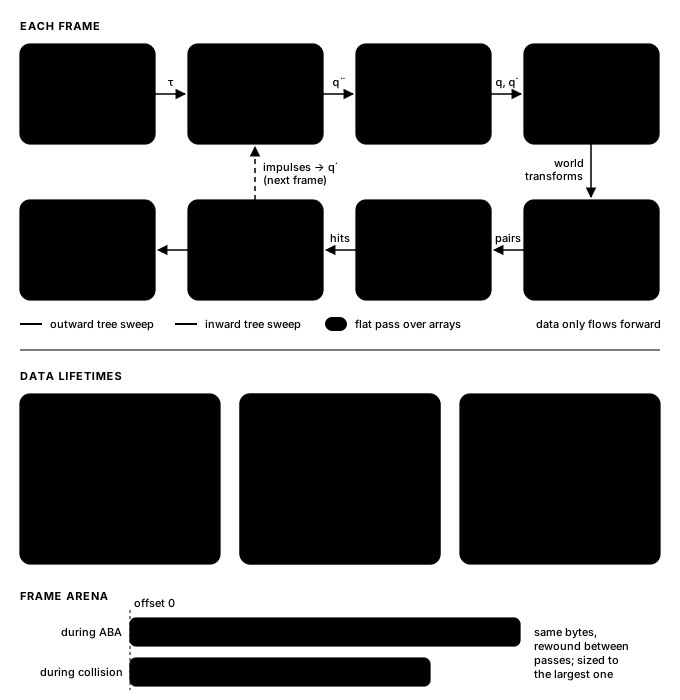
For V3, I wrote a full design document before writing any code. The target was concrete: simulate my club's six-robot arena of holonomic turret robots fast enough to train RL policies on a laptop CPU, since we don't have much GPU compute. Training takes millions of steps, so throughput was the goal, and V3 doubled as a performance learning exercise. One rule drove most decisions: only costs paid every frame matter. Only joint state, plus the contact solver's last solution, persists between frames. Everything else is either static data built at load time or scratch memory rebuilt each step and reused between passes. That rule became three pieces: fields; small operations that declare exactly which fields they read and write; and traversals that apply those operations across the joint tree, all checked at compile time. What the compiler can't check, the engine checks as it starts, and CI runs death tests confirming that a bad setup, like a model that doesn't fit its layout or an overflowing arena, stops it with a clear message instead of quietly corrupting a run. I kept V2's physically meaningful types but moved them into the math rather than the structure, so adding collisions or rendering meant adding passes instead of rewiring classes.

The V3 design: each frame runs eight passes in one direction (actuator torques, ABA forward dynamics, integration, kinematics, then broad phase, narrow phase, contact resolution and a debug render), and below it, which data is static, which persists between frames, and which is rebuilt each frame in a reused arena
V3 as designed. Collisions changed once I built them (see above).