Benchmarking VLAs for ARCHITECTBest example
Designing the benchmark: what makes a VLA test fair
- Code I wrote
- 178 lines
- Tools
- YAML configs
- Hardware
- Franka Panda
- Role
- Team
- Status
- In the paper
Also shows: Experiment design
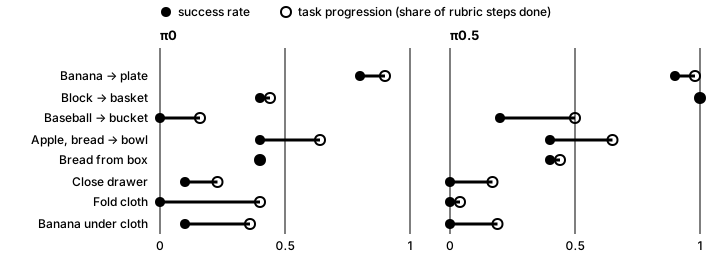
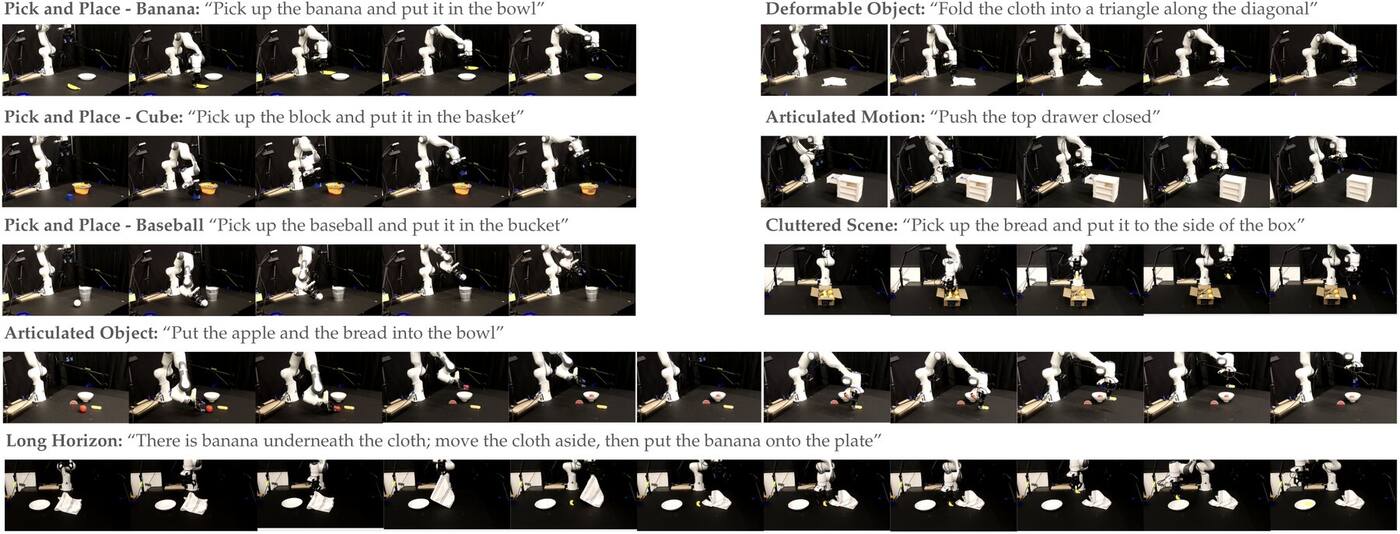
A VLA can look great near its training setup and fall apart a few centimeters away, so the hard part is deciding what a fair test is. We picked eight tasks across six kinds of challenge and changed the objects' placement and the wording on each of ten rollouts. We randomized the placements within a set workspace before running any evaluation, and every method ran the same ones. If I ran it again, the biggest thing I'd change is the lighting: we didn't control it well, and the models performed noticeably differently early in the morning than late at night.
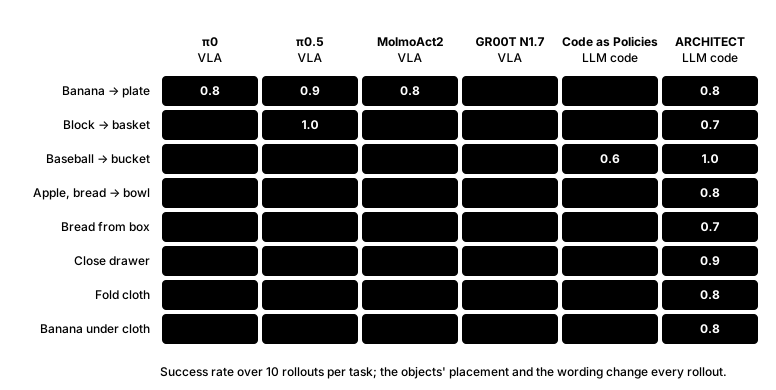
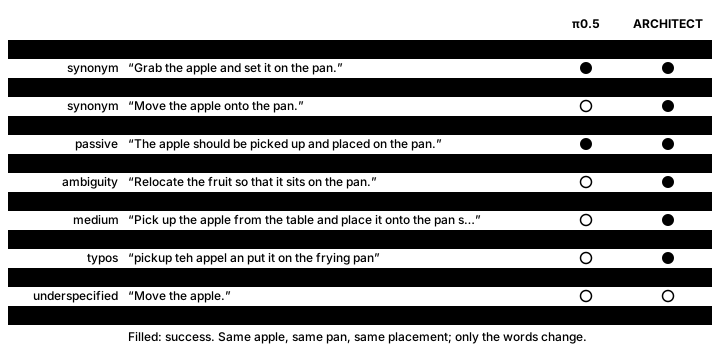
Success alone also hides a lot, so in the main benchmark each rollout was scored three ways: did it succeed, what fraction of the goals were met, and how far along a written rubric it got. Separately from that benchmark, we ran an ablation on wording alone: one task with the apple held still and only the instruction changed, fifteen phrasings run once each. π0.5 succeeded on "Grab the apple and set it on the pan" and failed on "Take the apple and place it onto the pan." It was sensitive to how specific the prompt was: given an underspecified one like "Put the apple away," the arm wandered without targeting the apple before eventually turning to the task, and an overly specified prompt degraded it the same way. It struggles when the task's intent is missing or buried.
MolmoAct2 was strong on the banana but struggled with the other pick-and-place tasks, which suggests it's fragile to object type, and on the harder tasks it often misread the prompt entirely, pressing the top of the cabinet instead of closing the drawer. It also disengaged early: in the two-object task it moved one object and withdrew, and in the cluttered box it picked the wrong object and never came back for the right one. Across all of it, the VLAs failed in the same few ways: sensitivity to how the prompt was worded, dependence on the object (π0 never got the baseball into the bucket), and poor spatial reasoning. They ignored vertical clearance, like the height of a barrier or how high to lift a cloth before setting it aside, and when a task called for a specific procedure they defaulted to another one that couldn't finish it, grabbing the drawer's lip instead of pushing it closed.