← All skills

Skill

Holonomic drive

Robots with mecanum or omni wheels that move in any direction. SKIDADDLE plans in the four wheels' motor space, and OpenDubs's first base drove four mecanum wheels.

3 log entries2 projects

FIRST Tech ChallengeBest example

Reworking SKIDADDLE's control

Code

Also shows: Motion planningJava

Over winter break I took SKIDADDLE apart into pieces that each do one job. Controllers now only ask for accelerations: one along the path, one back onto it, one for heading, each with a weight and a priority. A scheduler runs whichever are active, and a default controller brings the robot to a stop when none are. A new allocator turns the requests into motor space and hands out each motor's remaining headroom, highest priority first and shared by weight within a priority, so correcting off the path can come before speeding along it without any motor going past its limits. The look-ahead, before the most expensive part of the loop, became a precompute: when a path is made, one backward pass finds the fastest speed the robot can enter each turn at, so the loop only reads it.
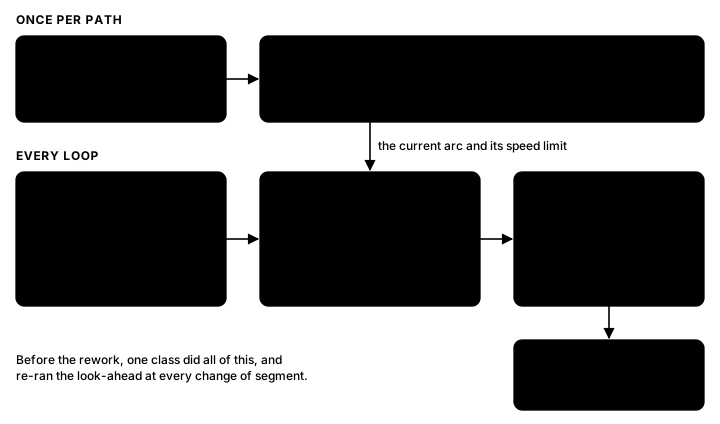
Diagram: once per path, a path generator feeds precomputed speed limits; every loop, controllers send requests to a scheduler, which feeds an allocator that drives the wheels
The follower after the rework.

Planning in motor space means a turn's sideways acceleration comes out of the same wheel budget as speeding up and slowing down. Road Runner limits acceleration only along the path, so on a tight hairpin at the same limits its plan asks for more grip than the wheels have, falls behind and overshoots the end. With its limit lowered to 30 in/s² it stays within 9 in; SKIDADDLE stays within 4.5 in and stops 0.7 s sooner. It isn't ahead everywhere: on sharp corners Road Runner with the lower limit tracks tighter, and the rework doesn't correct sideways error yet, so it can stop a few inches off the end point.
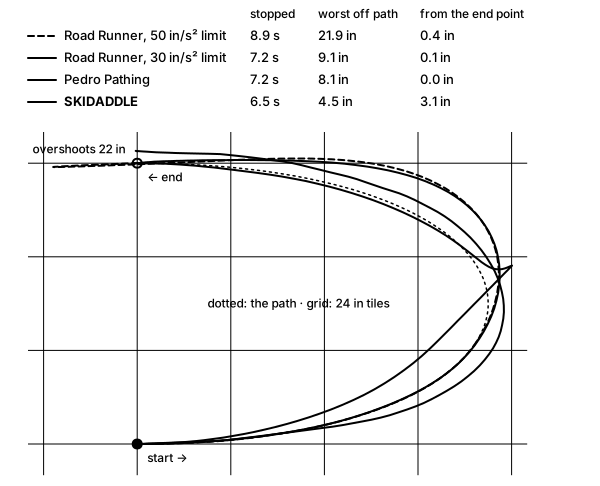
Four runs around the same hairpin. Road Runner at the shared 50 in/s² limit falls behind in the curve and overshoots the end by 22 in. With its limit lowered to 30 it strays 9.1 in and stops after 7.2 s. Pedro Pathing strays 8.1 in and stops after 7.2 s. SKIDADDLE strays 4.5 in, stops after 6.5 s, and ends 3.1 in from the end point
Simulated: one mecanum robot model and the same speed and acceleration limits for all three. Road Runner 1.0.1 and Pedro Pathing 3.0.2 run from their source; SKIDADDLE's plan is followed with feedforward and a position term.

FIRST Tech Challenge

SKIDADDLE: a path follower that plans with physics

Code

Also shows: Motion planningJavaOpen source

SKIDADDLE is a path-following library for FTC robots, written in Java, that I built to fix inefficiencies in Road Runner, the usual FTC path library, and get better paths. It plans with a physics model of the robot, and I derived all of its math by hand, myself, without AI or earlier work to build on. A path, a cubic Bézier for autonomous or a Hermite spline built on the fly in tele-op, is flattened into straight segments by adaptive De Casteljau subdivision, and a curve whose turns would need more than the robot's acceleration is relaxed until they don't. Every loop it splits the robot's velocity into a convergent part, toward the goal, and a transverse part, everything else. It first spends its acceleration budget cancelling the transverse part, then speeds up the convergent part, so from any starting position or velocity the robot converges on the path. A look-ahead over the stopping distance sets the fastest speed for each corner, and the robot switches segments when its braking distance says it must. Heading is a separate controller, and the result goes through PIDF and feedforward to the four wheels. A simulator draws the field and graphs every step.

SKIDADDLE's own simulator following a cubic Bézier path, in real time.
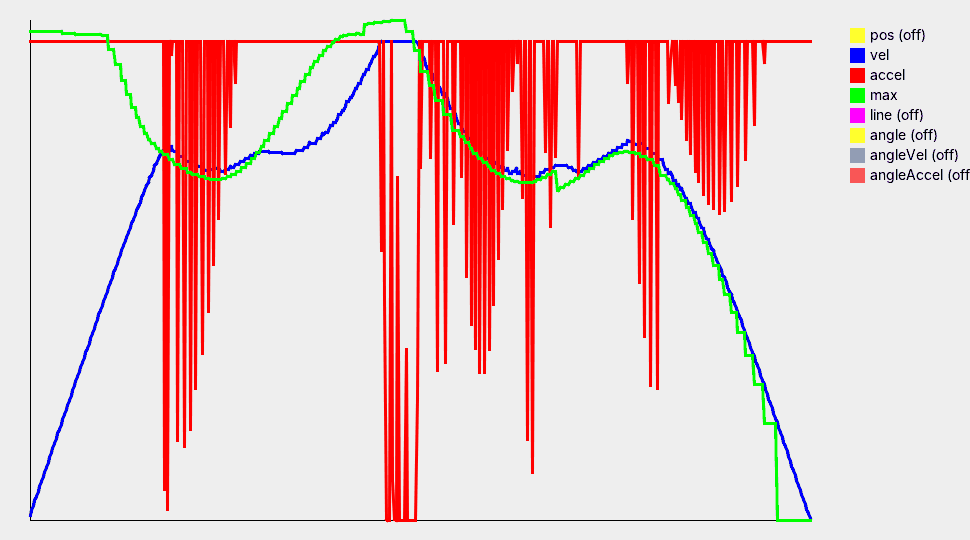
Line chart over the run: blue speed rises, follows the green speed limit through the turns and falls to zero at the end; the red acceleration sits at its cap and drops whenever the speed reaches the limit
The simulator's graph of the same run: speed (blue) tracking the look-ahead's speed limit (green), acceleration (red) mostly at its cap.

OpenDubs

Bring-up: the Thor, Docker and the drive code

Rosbag recorder

Also shows: ROS 2Hardware bring-up

OpenDubs runs on an NVIDIA Jetson Thor, so the first job was getting it ready for the whole team. I flashed JetPack onto it, got its IO talking to the rest of the robot, and set up the Docker environment we all develop in: a ROS 2 image with the build tools, Makefile and VS Code tasks to build and debug inside it, and per-person git identities so four people can commit from one shared machine.

The first version of the base drove its four mecanum wheels through a Pixhawk running ArduPilot, over MAVROS; it has since dropped the Pixhawk. With another intern, I brought up that drive code, then added what the rest of the stack needed: a URDF and an SDF with collision geometry for RViz and Gazebo, and a service that records topics to rosbags. Every test after this was a bag I could replay.

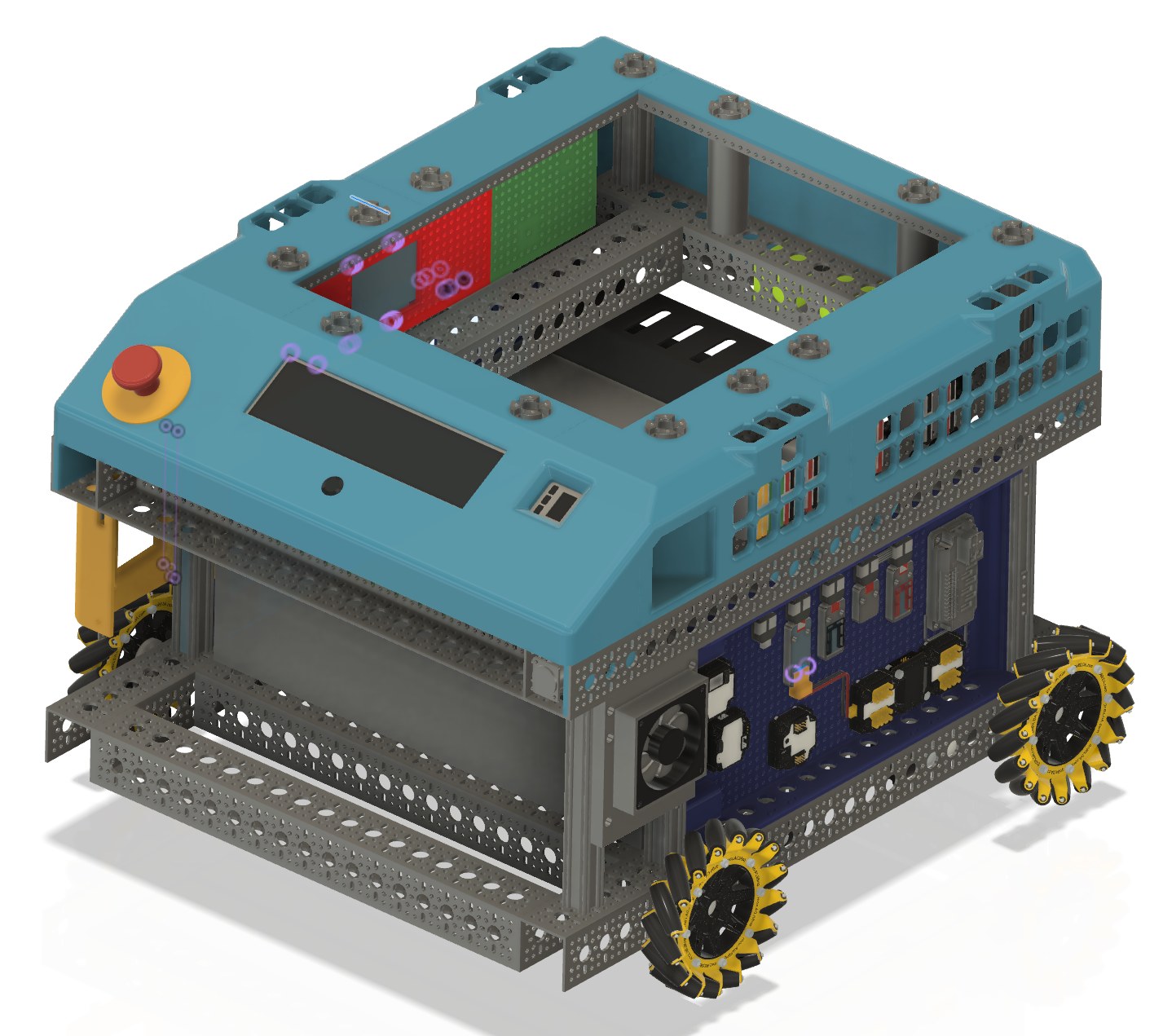
The base has since been rebuilt by others in the lab (I didn't work on it), without the Pixhawk, and carries everything else: a 51.2 V LiFePO4 battery, an emergency stop on the deck and a status display, all wired into one aluminum frame, with the arms, the Thor and the lidars riding on top.

A CAD render of the rover base: an aluminum frame with blue panels, mecanum wheels and an emergency stop on the top deck
The base, in CAD.
The base driving down the hallway, August 28.