← All skills

Skill

Open source

Publishing and contributing code others use. My fix to the lab's IK solver landed upstream, and SKIDADDLE is a public FTC library.

2 log entries2 projects

OpenDubsBest example

Fixing the IK solver for the OpenArm

The fixPull request

Also shows: Kinematics & DynamicsPython

Teleop and planning both lean on ssik, the lab's analytical IK solver, which I didn't write, and on the OpenArm it kept failing. I traced it to a singularity in the solver itself: the OpenArm's joint axes meet at shared points, so its link lengths are zero and every twist is a right angle, and that exact geometry breaks the Raghavan–Roth elimination the solver uses. My fix nudges those zero lengths by a tiny fraction of the arm's size, so the solver works on an arm a hair off the real one, then, since forward kinematics is cheap, refines the answer against the true arm's FK, step after step, until it's an exact solution again. The maintainer confirmed the fix would have worked while landing the same one upstream.
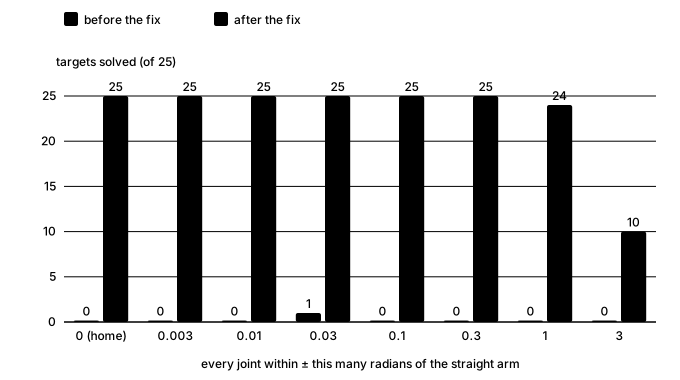
Bar chart of IK targets solved on the OpenArm, 25 per distance from the straight arm, from 0 to 3 radians: before the fix, 1 of 200 in all; after it, every target out to 0.3 radians, 24 at 1 radian and 10 at 3
My July OpenArm IK (ssik's joint-lock solver) on 200 random reachable targets, run again with ssik just before my fix and with it: 1 solved before, 184 after.

FIRST Tech Challenge

SKIDADDLE: a path follower that plans with physics

Code

Also shows: Motion planningJava

SKIDADDLE is a path-following library for FTC robots, written in Java, that I built to fix inefficiencies in Road Runner, the usual FTC path library, and get better paths. It plans with a physics model of the robot, and I derived all of its math by hand, myself, without AI or earlier work to build on. A path, a cubic Bézier for autonomous or a Hermite spline built on the fly in tele-op, is flattened into straight segments by adaptive De Casteljau subdivision, and a curve whose turns would need more than the robot's acceleration is relaxed until they don't. Every loop it splits the robot's velocity into a convergent part, toward the goal, and a transverse part, everything else. It first spends its acceleration budget cancelling the transverse part, then speeds up the convergent part, so from any starting position or velocity the robot converges on the path. A look-ahead over the stopping distance sets the fastest speed for each corner, and the robot switches segments when its braking distance says it must. Heading is a separate controller, and the result goes through PIDF and feedforward to the four wheels. A simulator draws the field and graphs every step.

SKIDADDLE's own simulator following a cubic Bézier path, in real time.
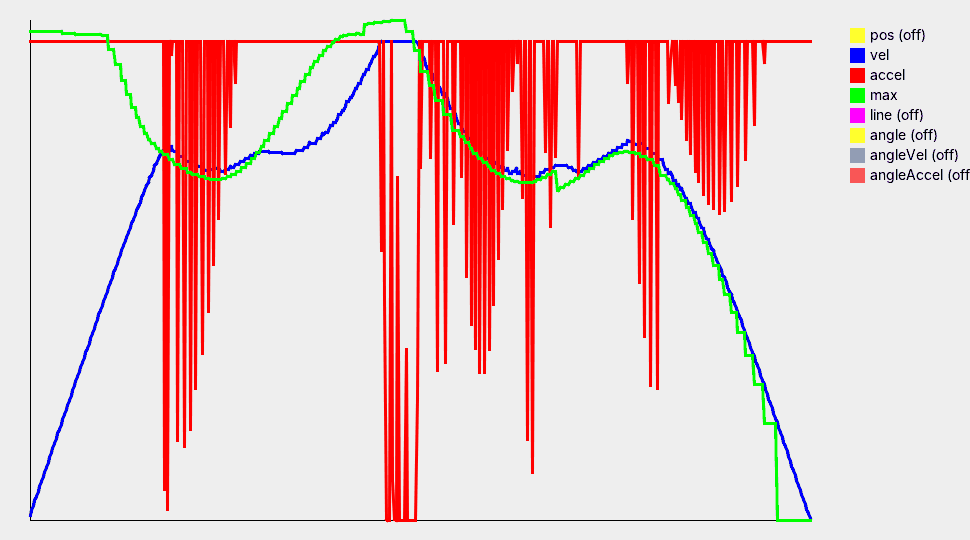
Line chart over the run: blue speed rises, follows the green speed limit through the turns and falls to zero at the end; the red acceleration sits at its cap and drops whenever the speed reaches the limit
The simulator's graph of the same run: speed (blue) tracking the look-ahead's speed limit (green), acceleration (red) mostly at its cap.