The same check for a 2D lidar
- Code I wrote
- 769 lines
- Language
- Python
- Tools
- ROS 2
- Hardware
- LD19 lidar
- Role
- Solo
- Status
- Done
Skills: ROS 2State estimation
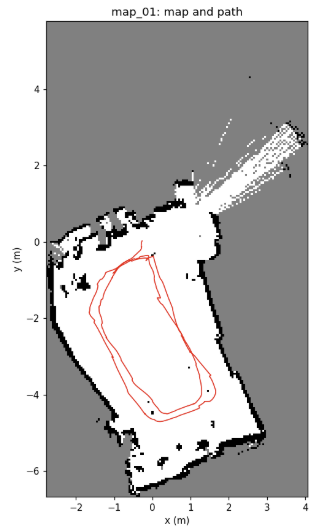
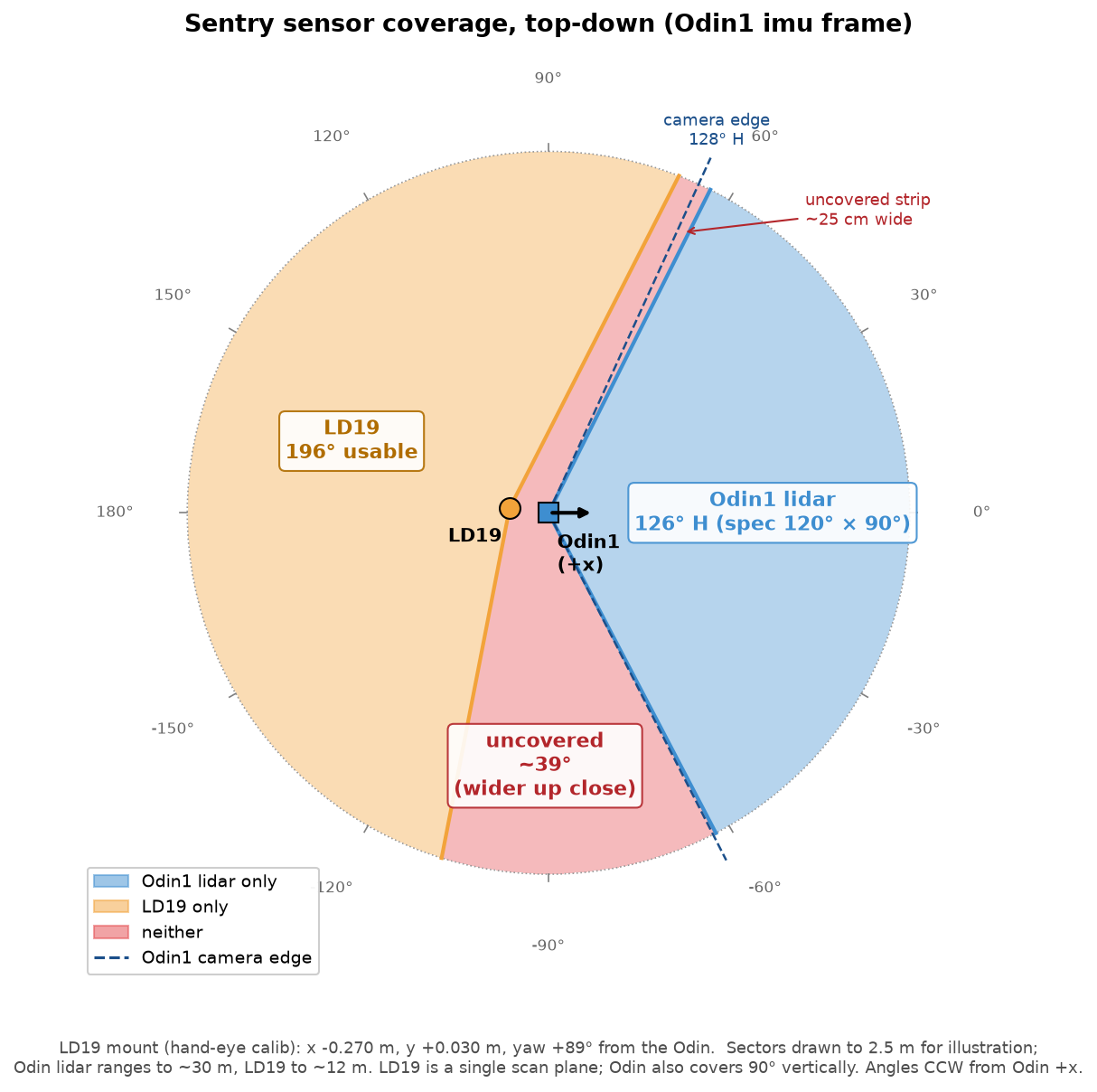
I ran the same characterization on a WayPonDEV LD19 2D lidar, for obstacle mapping, with the Odin providing the pose. It scans at a steady 10 Hz with 8–14 ms of jitter, about 503 points per scan 0.72° apart, and skips 1–2% of scans. Range noise is 3–6 mm at 1–2 m, 6–11 mm at 2–3 m and 7–28 mm at 3–5 m: well under a 5 cm map cell, even at 5 m. At most 0.2% of returns are isolated false points and 1–2.4% are outliers, mostly at object edges where a beam half-hits the edge and half the background, which a filter removes easily. It never dropped off USB in the 40 minutes it ran, and the longest gap between scans was one skipped scan. The LD19 was good enough for our use, but we bought a 3D lidar anyway: the Odin's field of view is small, and a 3D lidar sees much more of the area around the robot.