← All skills

Skill

NVIDIA Jetson

NVIDIA's embedded computers. OpenDubs runs on a Jetson Thor that I flashed and set up for the team.

3 log entries1 project

OpenDubsBest example

Bring-up: the Thor, Docker and the drive code

Rosbag recorder

Also shows: ROS 2Hardware bring-up

OpenDubs runs on an NVIDIA Jetson Thor, so the first job was getting it ready for the whole team. I flashed JetPack onto it, got its IO talking to the rest of the robot, and set up the Docker environment we all develop in: a ROS 2 image with the build tools, Makefile and VS Code tasks to build and debug inside it, and per-person git identities so four people can commit from one shared machine.

The first version of the base drove its four mecanum wheels through a Pixhawk running ArduPilot, over MAVROS; it has since dropped the Pixhawk. With another intern, I brought up that drive code, then added what the rest of the stack needed: a URDF and an SDF with collision geometry for RViz and Gazebo, and a service that records topics to rosbags. Every test after this was a bag I could replay.

The base has since been rebuilt by others in the lab (I didn't work on it), without the Pixhawk, and carries everything else: a 51.2 V LiFePO4 battery, an emergency stop on the deck and a status display, all wired into one aluminum frame, with the arms, the Thor and the lidars riding on top.
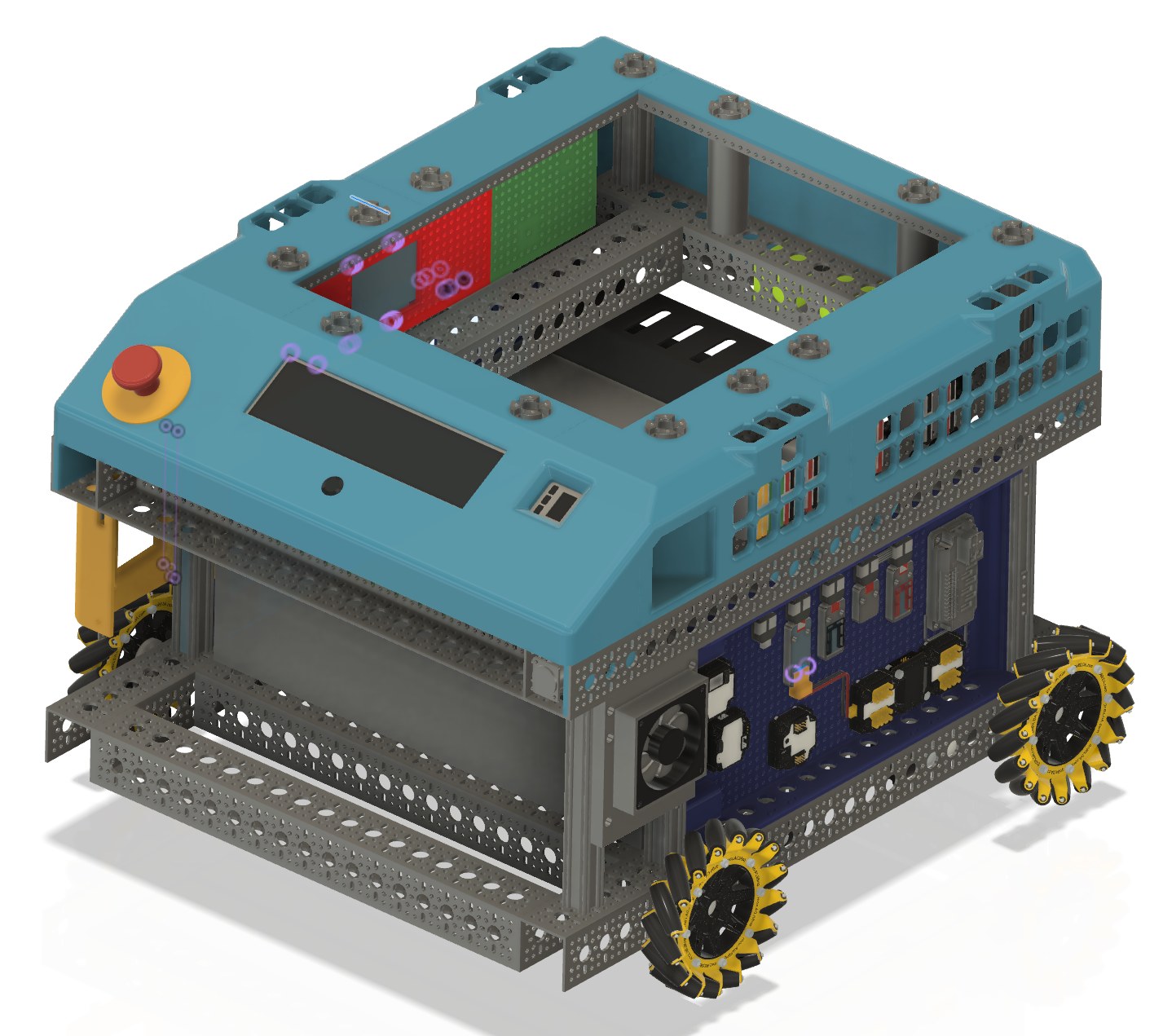
A CAD render of the rover base: an aluminum frame with blue panels, mecanum wheels and an emergency stop on the top deck
The base, in CAD.
The base driving down the hallway, August 28.

OpenDubs

Arm control: three impedance controllers, then a simpler one

Cartesian controlJoint and null-space control

Also shows: Impedance controlC++ROS 2

Each arm is a 7-DOF OpenArm whose Damiao motors run their own impedance loop: the Thor sends position, velocity and torque targets with gains over CAN-FD, and each motor closes the loop itself. I measured the stock ROS 2 stack first. A goal is accepted in 2.55 ms, and with both arms holding one block, 47 ms passes between a command to one arm and the torque spike in the other (σ = 4.7 ms).

What I was after was axial compliance in Cartesian space: a gripper that holds firm along some axes and gives along others. I wrote three controllers with Pinocchio to get it (Cartesian, joint and null space). Pure Cartesian impedance gave that compliance, but it left the redundant elbow free to drift off the collision-checked path. The combined controller ran joint-space impedance and subtracted the Cartesian terms from it, keeping the axial compliance and control of the null space, but it was numerically unstable. The null-space controller worked, but I switched off it for the much lower latency of the motors' own impedance loops: in the end we gave up Cartesian compliance for speed.

What I settled on is simpler: the planned trajectory goes straight to the motors, plus gravity compensation at 500 Hz from Pinocchio's RNEA (the recursive Newton-Euler algorithm), with every goal checked against position and torque limits in both joint space and Cartesian space (through forward kinematics).

My Cartesian impedance controller on the robot: gravity compensation only (June 26), stiff in x and y but compliant in z and rotation, and stiff in x and y but compliant in rotation.
The four controllers in MuJoCo, built unchanged from their repos (faint arm: the plan). On the reaches the motors' own loop stays within about 2 cm of the plan while the others trail by 7 to 18 cm; near the straight arm the Cartesian one stays folded once pushed. Demo gains.

OpenDubs

Two 2D lidars, merged into one scan

Also shows: State estimationROS 2Hardware bring-upPython

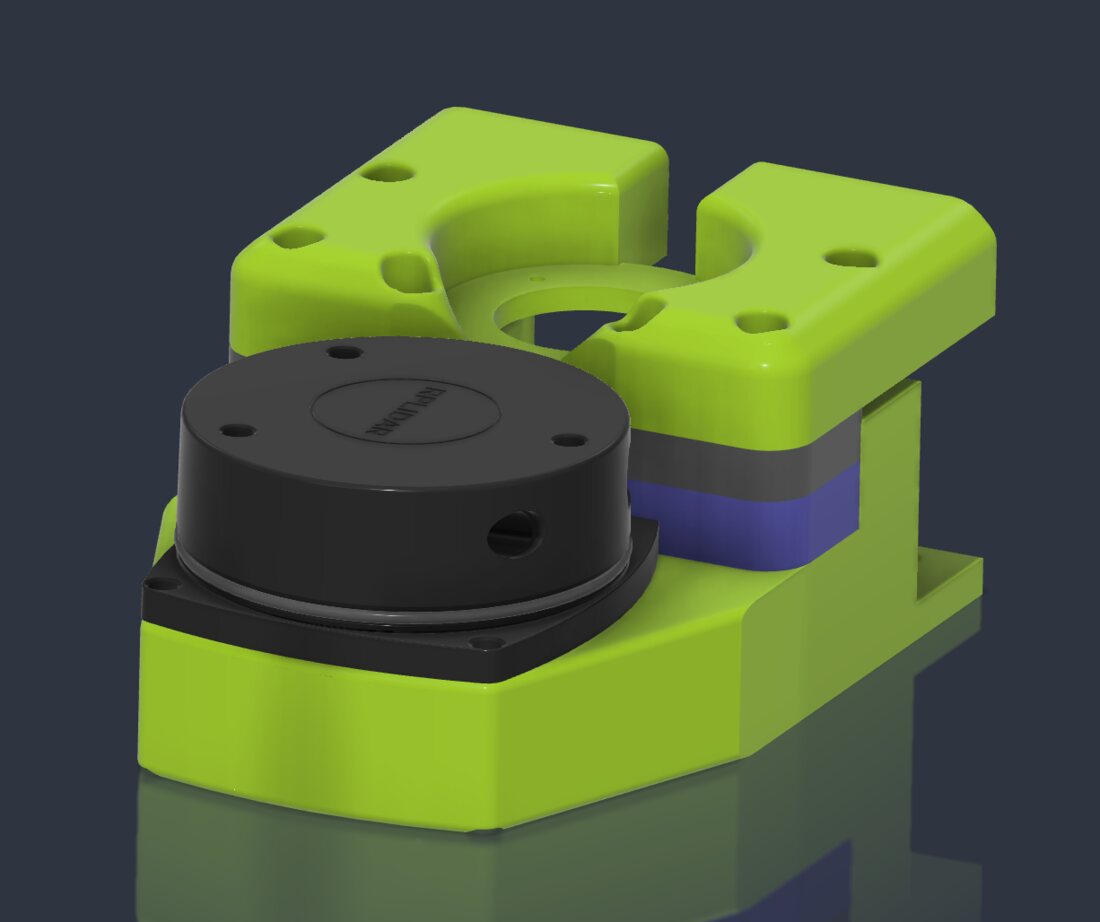
For localization and a map, the base carries two RPLIDAR A1 2D lidars, one at the front and one at the back. Bringing them up, with the team, was mostly fighting USB: the two units have identical USB IDs, so udev rules name each by the hub port it's plugged into, and they power up a few seconds apart so neither times out.

Mapping and Nav2 expect one scan, so I wrote a node that merges the two. The two scans never line up on their own: nothing guarantees the lidars spin at exactly the same rate or finish a revolution at the same moment, and each reaches the Thor with its own latency. So the node pairs scans by their timestamps (any two within 0.1 s), looks up each scan's transform into the robot's frame at that scan's own timestamp, resamples both to the finer of the two angular resolutions, and keeps the nearest return in each direction of one 360° scan, stamped halfway between the two and dropping hits on the robot itself. On top of it, I set up slam_toolbox and Nav2, which drove the robot point to point in simulation.

A CAD render of a round 2D lidar sitting in a bright green 3D-printed mount
One of the two lidar mounts. CAD render from the lab's build guide.
A replay in Gazebo: the robot's URDF, my lidar merger and our slam_toolbox settings, unmodified, mapping a made-up lab room while Nav2 drives. 6× speed.