← All skills

Skill

Competitive robotics

Building robots to win competitions. ARUW in DJI's ARC and my FTC team's robots, path following and driver tools.

5 log entries2 projects

Advanced Robotics at UWBest example

The competition and our robots

Robot revealChampionship matchARUW

Advanced Robotics at UW competes in ARC, DJI's robotics competition for universities in North America (RoboMaster North America until 2025). Every season the team designs and builds a fleet of eight robots, most of them new (this year's reveal), for what the team calls a deathmatch somewhere between paintball and League of Legends. Operators drive their robots through an onboard camera and fire 17 mm and 42 mm projectiles at the pressure-sensitive armor plates on the other team's robots, while fighting king-of-the-hill style for a capture point in the middle of the field, in matches that are each a best of three. The engineer can't shoot: it collects minerals to trade for coins that buy supplies during the match. The sentry is the only fully autonomous robot on the field, finding its own way around and aiming on its own. ARUW won the competition every year from 2021 to 2024. At the 2026 ARC Championship at Purdue we placed third in the 3v3, second in the dart event and third in the drone event; for it I worked on the engineer's odometry and path tracking, and since then I've moved to the sentry's localization and navigation.
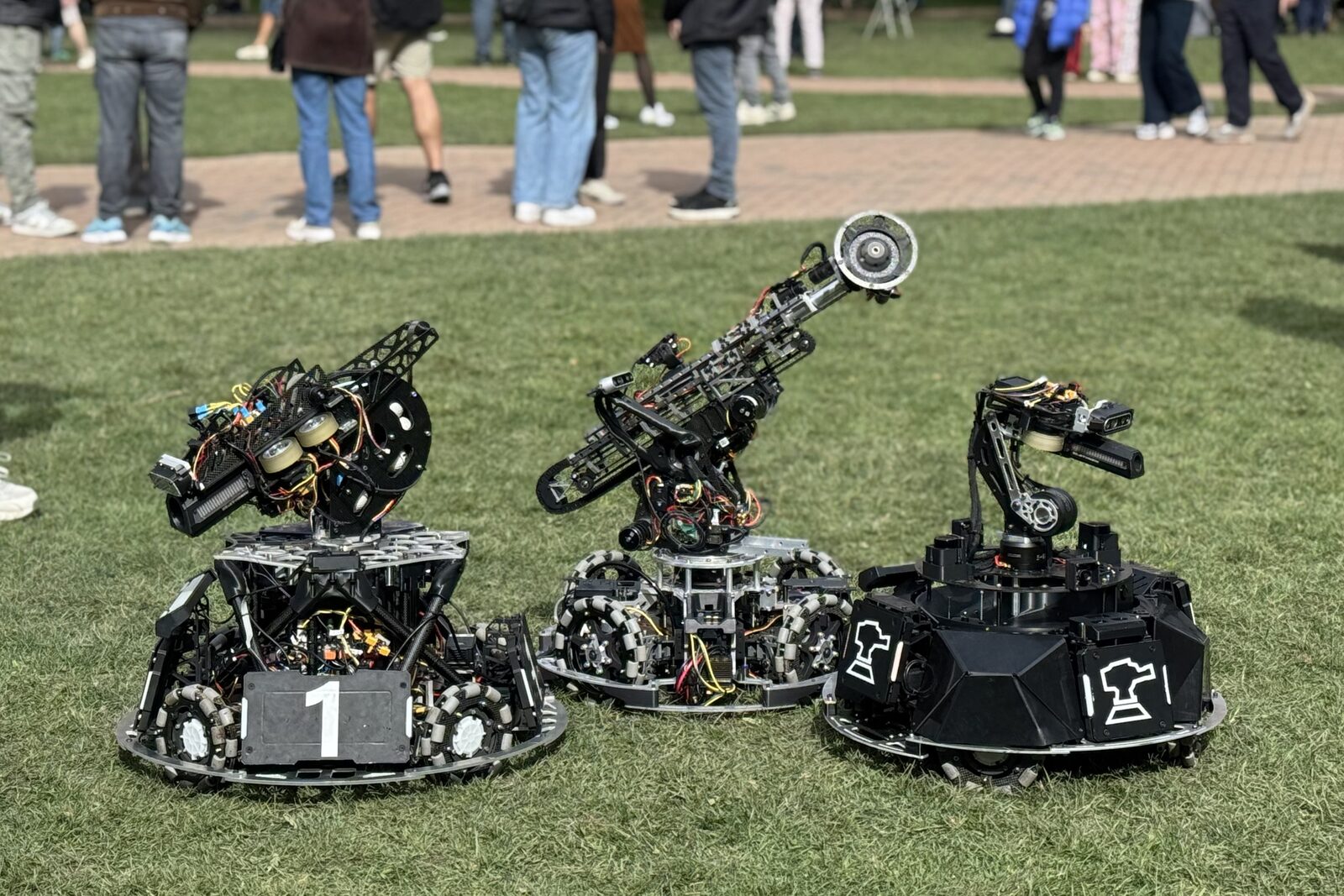
Three of ARUW's 2026 robots side by side on the grass, two with long launcher barrels and the black-shelled sentry on the right, with visitors' legs in the background
The sentry (right) and two of our other 2026 robots on the Quad in cherry blossom season.
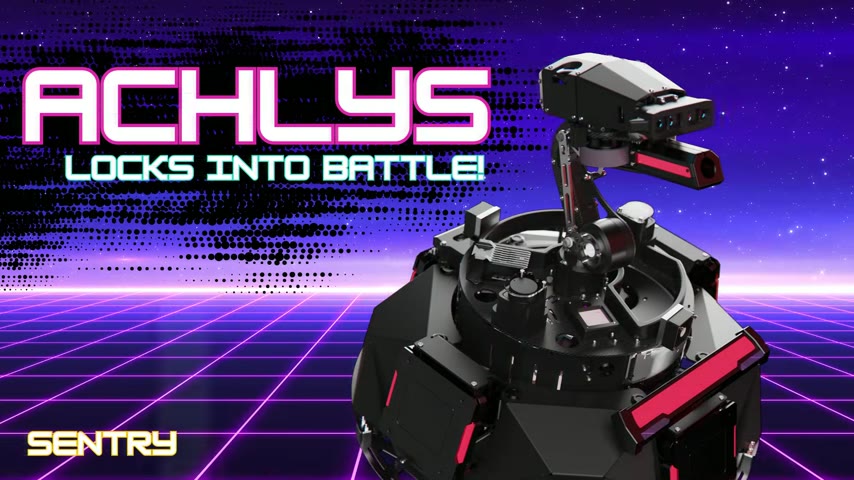
Watch on YouTube: Our 2026 robot reveal
Our 2026 robot reveal · YouTube

Advanced Robotics at UW

Kalman-filter odometry for three dead wheels

8-state filterSplit filters

Also shows: State estimationC++

Our robots know where they are from dead wheels: small unpowered tracking wheels with encoders that roll along the floor. When the engineer robot moved to new odometry pods with three of them, I rewrote the team's Kalman-filter odometry for them; I had taught myself Kalman filters from Kalman Filter from the Ground Up. The first version was one 8-state filter fusing the three wheels with the IMU. Its covariance between heading and the x and y motion turned out to be negligible, so I split it into three independent two-state filters, for x, y and heading, each updated by one measurement: every step now multiplies 2×2 matrices and divides by a number, instead of working through 8×8 matrices and inverting a 7×7 one, and the wheels alone turned out to be enough without the IMU. To tune it, I drove fixed paths (straight forward, straight sideways, spins and a square), logged the raw wheels, and replayed them offline to fit each pod's position, angle and wheel radius and the filter's noise, checking the result against the IMU's heading. Our target was under 10 cm of error over the engineer's path, the most our vision system could correct for, and the tuned odometry met it.

The engineer driving itself at competition, from the third cube pickup to its drop-off: the filter's own logged pose, replayed at real time from just before it moves.
Tuning offline: a logged 5 m sideways push, replayed through the filter as the pods move from their design values to the tuned ones. With one pod 2.7° off straight, the design values read the push as a 79° turn; tuned, it comes to 4.99 m and follows the path the IMU's heading gives, ending within 1° of it.

FIRST Tech Challenge

Two robots, so software never waits

Also shows: Technical leadership

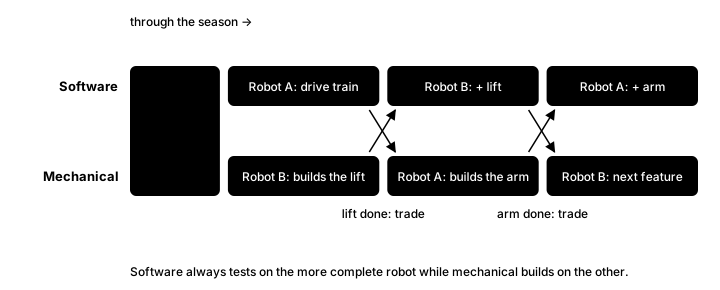
As captain I set up a new way to build our robot: two robots developed in parallel. While the CAD was being finished, we assembled the drive trains. Software then got the first robot, a bare drive train, to test on, while mechanical integrated the first feature, such as the lift, on the second. Once that feature passed our definition of done, the teams traded: software integrated the feature and kept developing, and mechanical moved on to the next feature, like the arm, on the other robot, and the trading continued all season. Software was always testing on a competition-ready robot while mechanical kept building, our drivers got more practice before the robot was feature complete, and we would have had a robot ready for competition even if mechanical badly missed a deadline.

Timeline in two rows, software and mechanical: after the CAD and drive trains, software tests on robot A while mechanical builds the lift on robot B; at each definition of done the two teams trade robots, so software takes the robot with the newest feature and mechanical builds the next feature on the other
The hand-off: at each definition of done, the two teams trade robots.

FIRST Tech Challenge

SKIDADDLE: a path follower that plans with physics

Code

Also shows: Motion planningJavaOpen source

SKIDADDLE is a path-following library for FTC robots, written in Java, that I built to fix inefficiencies in Road Runner, the usual FTC path library, and get better paths. It plans with a physics model of the robot, and I derived all of its math by hand, myself, without AI or earlier work to build on. A path, a cubic Bézier for autonomous or a Hermite spline built on the fly in tele-op, is flattened into straight segments by adaptive De Casteljau subdivision, and a curve whose turns would need more than the robot's acceleration is relaxed until they don't. Every loop it splits the robot's velocity into a convergent part, toward the goal, and a transverse part, everything else. It first spends its acceleration budget cancelling the transverse part, then speeds up the convergent part, so from any starting position or velocity the robot converges on the path. A look-ahead over the stopping distance sets the fastest speed for each corner, and the robot switches segments when its braking distance says it must. Heading is a separate controller, and the result goes through PIDF and feedforward to the four wheels. A simulator draws the field and graphs every step.

SKIDADDLE's own simulator following a cubic Bézier path, in real time.
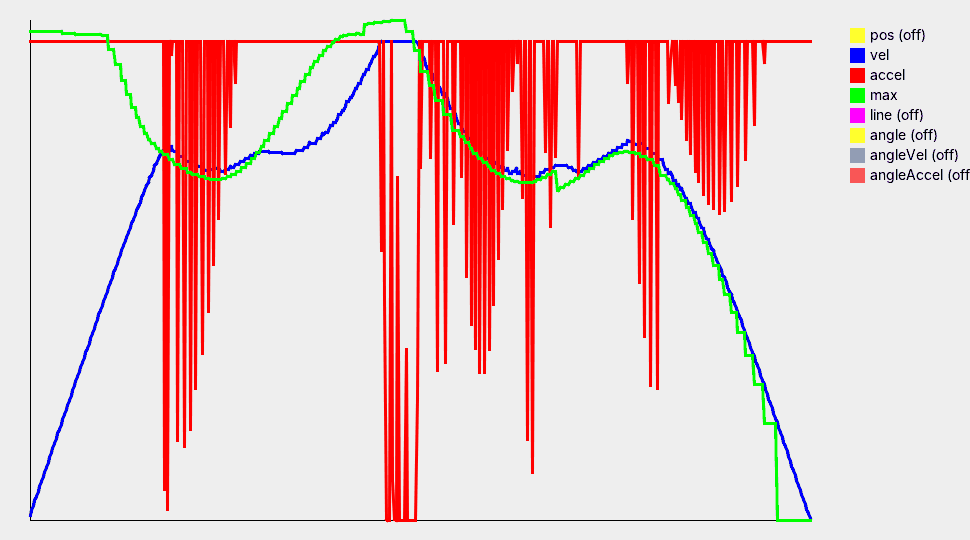
Line chart over the run: blue speed rises, follows the green speed limit through the turns and falls to zero at the end; the red acceleration sits at its cap and drops whenever the speed reaches the limit
The simulator's graph of the same run: speed (blue) tracking the look-ahead's speed limit (green), acceleration (red) mostly at its cap.

FIRST Tech Challenge

Live View: camera video sent as text

Code

Also shows: Java

FTC rules ban streaming camera images to the driver station during a match, but telemetry text is allowed, so Live View sends the robot's camera feed as text. Each frame is shrunk and converted to the Lab colour space on the robot, then drawn with Braille characters as pixels: each character is a 2×4 block of dots, and Floyd–Steinberg dithering decides which dots are on, so shading survives with only on and off. To keep the message small, colour is added only for the game pieces: runs of characters that match the yellow, red or blue samples are wrapped in a colour tag, and only the 100 longest runs are kept. The text goes out as HTML telemetry ten times a second. It gave our drivers a view of what the robot could see during matches, within the rules.

Live View on the driver station: every frame is text.