← All skills

Skill

Manipulation

Robot arms grasping and moving things. OpenDubs's arms, the Fleet RL peg reset, and the VLA benchmark's pick-and-place, drawer and cloth tasks.

5 log entries3 projects

OpenDubsBest example

N arms, one planner: ArmGroup

Pull request

Also shows: Motion planningPythonSimulation (MuJoCo)

The lab plans with its own MuJoCo planning library, mj_manipulator, which planned one arm at a time. With two arms on one torso, two plans that are each safe can still hit each other. I added an ArmGroup to it that plans all arms' joints together, so every step is checked arm against arm. On the clip's goals, the two arms planned separately collide in 58 of 210 frames; ArmGroup's plan bends one gripper about 16 cm around the other and touches in none. The same group plans to joint goals, gripper poses and lockstep Cartesian paths, keeps 5 mm between all geometry, retimes the trajectory at 125 Hz, and re-checks it at every sample. I made single-arm planning a one-arm group, and ArmGroup is what plans both arms on the robot today.

The same goals, each arm planned on its own (left, red while they intersect) and planned together by ArmGroup (right). The lines are the grippers' paths. MuJoCo, real time.
A two-arm handover planned with ArmGroup in MuJoCo (the can is carried kinematically).

Fleet RL

Resetting the peg without a person

Code

Also shows: Robot learningMotion planningPython

In online RL an arm practises a task over and over, so after every try something has to put the peg back where the task starts. I built that reset for the peg-insertion task. A teammate and I designed the tagging together, and they wrote the code that reads it: ten AprilTags on the peg's faces, from which the scene camera solves the peg's full pose. I calibrated each camera with a ChArUco board, first its lens (the intrinsics), then its pose relative to the arm (the extrinsics). For the second, a calibration script has the arm set the tagged peg down at a grid of spots on the board and fits the arm's joint zeros and the camera's pose to where the arm thought the peg was against where the camera saw it. With that, the reset finds the peg anywhere in the workspace, works out how it is lying, and plans every waypoint of the pick and the place before the arm moves, choosing the grasp the arm can reach with the least travel within its joint limits. It then checks where the peg landed. This lets the teammate's automatic success detection score each try, so the arms can run online RL on their own. The reset has run on a real arm; the clip shows the same planner in simulation.

Four resets from four scrambled spots, planned by the reset code and shown in simulation at 2× speed.
Four views of the square peg with a tag on the top, the bottom and two on each side face, numbered 0 to 9, with a red arrow marking each tag's top edge
Where the ten tags go on the peg.

Benchmarking VLAs for ARCHITECT

Designing the benchmark: what makes a VLA test fair

Task configs

Also shows: Experiment designRobot learning

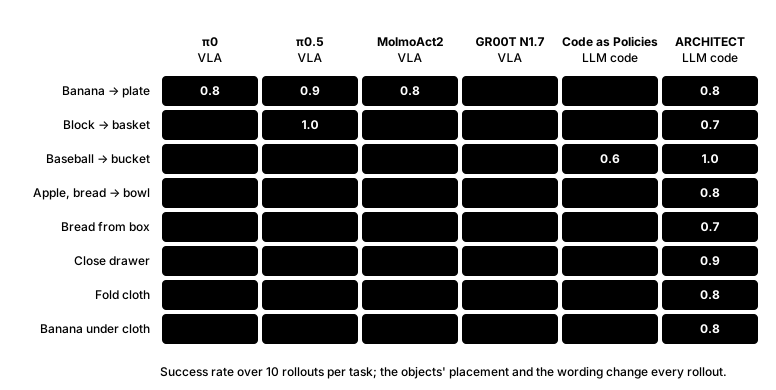
A VLA can look great near its training setup and fall apart a few centimeters away, so the hard part is deciding what a fair test is. We picked eight tasks across six kinds of challenge and changed the objects' placement and the wording on each of ten rollouts. We randomized the placements within a set workspace before running any evaluation, and every method ran the same ones. If I ran it again, the biggest thing I'd change is the lighting: we didn't control it well, and the models performed noticeably differently early in the morning than late at night.

Grid of success rates for eight tasks and six methods. The four VLAs score well only on simple pick and place, led by π0.5 at 0.9 and 1.0, and near zero on the drawer, the cloth fold and the banana under a cloth. Code as Policies peaks at 0.6. ARCHITECT scores 0.7 to 1.0 on every task
Success rate over 10 rollouts per task, from the paper's Tables 1 and 2.
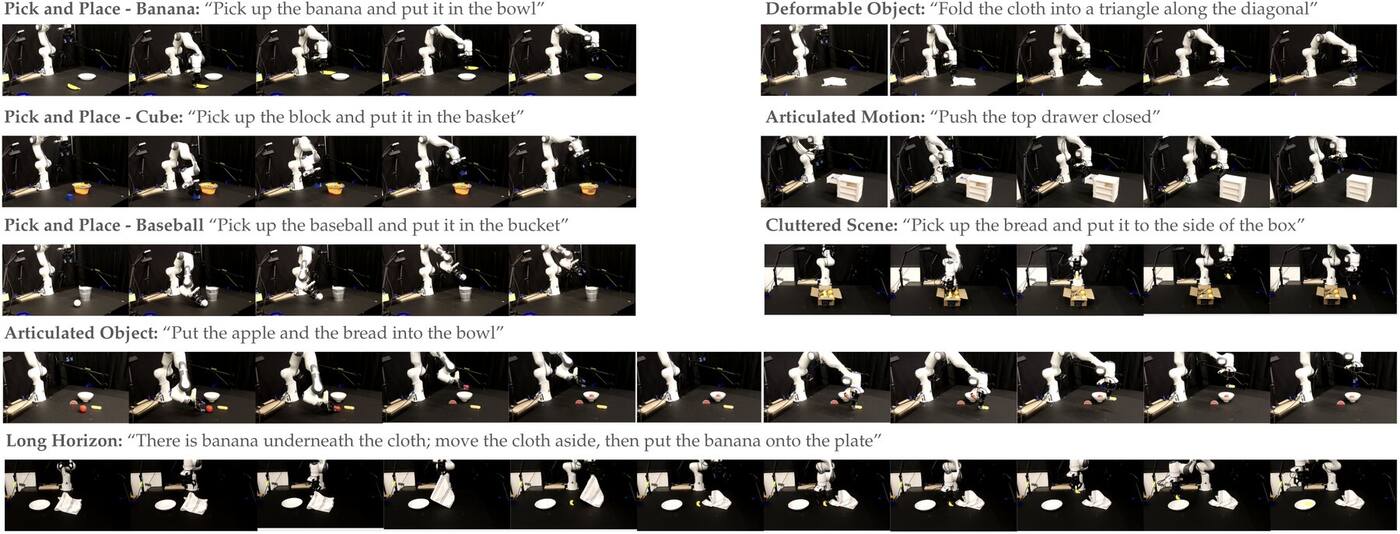
Filmstrips of the eight evaluation tasks on the Franka, each labeled with its challenge and instruction: three pick and place tasks, a two-object pick and place, picking bread from a cluttered box, closing a drawer, folding a cloth and uncovering a banana
The eight tasks, from the paper's Figure 3.

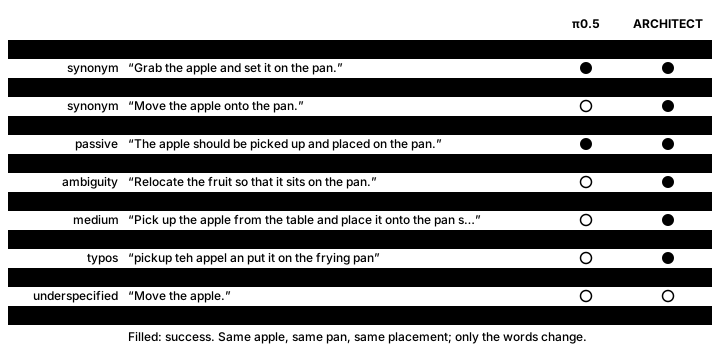
Success alone also hides a lot, so in the main benchmark each rollout was scored three ways: did it succeed, what fraction of the goals were met, and how far along a written rubric it got. Separately from that benchmark, we ran an ablation on wording alone: one task with the apple held still and only the instruction changed, fifteen phrasings run once each. π0.5 succeeded on "Grab the apple and set it on the pan" and failed on "Take the apple and place it onto the pan." It was sensitive to how specific the prompt was: given an underspecified one like "Put the apple away," the arm wandered without targeting the apple before eventually turning to the task, and an overly specified prompt degraded it the same way. It struggles when the task's intent is missing or buried.

MolmoAct2 was strong on the banana but struggled with the other pick-and-place tasks, which suggests it's fragile to object type, and on the harder tasks it often misread the prompt entirely, pressing the top of the cabinet instead of closing the drawer. It also disengaged early: in the two-object task it moved one object and withdrew, and in the cluttered box it picked the wrong object and never came back for the right one. Across all of it, the VLAs failed in the same few ways: sensitivity to how the prompt was worded, dependence on the object (π0 never got the baseball into the bucket), and poor spatial reasoning. They ignored vertical clearance, like the height of a barrier or how high to lift a cloth before setting it aside, and when a task called for a specific procedure they defaulted to another one that couldn't finish it, grabbing the drawer's lip instead of pushing it closed.

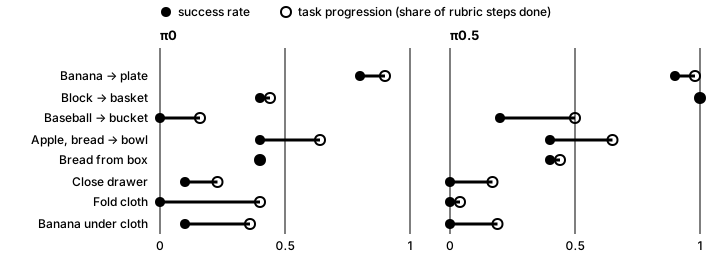
For π0 and π0.5 on each task, success rate beside task progression. On the hard tasks success is 0 to 0.1 while progression is often higher, such as π0 reaching 0.40 of the cloth fold
Why one number isn't enough: success against how far the policy got.
Fifteen phrasings of the same apple-to-pan instruction, with π0.5 and ARCHITECT marked for each. π0.5 succeeds on 6, failing on synonyms, reordered and ambiguous wording, typos and under- or over-specified instructions. ARCHITECT succeeds on 13
The language ablation: one task, fifteen phrasings, each run once.

OpenDubs

Arm control: three impedance controllers, then a simpler one

Cartesian controlJoint and null-space control

Also shows: Impedance controlC++ROS 2

Each arm is a 7-DOF OpenArm whose Damiao motors run their own impedance loop: the Thor sends position, velocity and torque targets with gains over CAN-FD, and each motor closes the loop itself. I measured the stock ROS 2 stack first. A goal is accepted in 2.55 ms, and with both arms holding one block, 47 ms passes between a command to one arm and the torque spike in the other (σ = 4.7 ms).

What I was after was axial compliance in Cartesian space: a gripper that holds firm along some axes and gives along others. I wrote three controllers with Pinocchio to get it (Cartesian, joint and null space). Pure Cartesian impedance gave that compliance, but it left the redundant elbow free to drift off the collision-checked path. The combined controller ran joint-space impedance and subtracted the Cartesian terms from it, keeping the axial compliance and control of the null space, but it was numerically unstable. The null-space controller worked, but I switched off it for the much lower latency of the motors' own impedance loops: in the end we gave up Cartesian compliance for speed.

What I settled on is simpler: the planned trajectory goes straight to the motors, plus gravity compensation at 500 Hz from Pinocchio's RNEA (the recursive Newton-Euler algorithm), with every goal checked against position and torque limits in both joint space and Cartesian space (through forward kinematics).

My Cartesian impedance controller on the robot: gravity compensation only (June 26), stiff in x and y but compliant in z and rotation, and stiff in x and y but compliant in rotation.
The four controllers in MuJoCo, built unchanged from their repos (faint arm: the plan). On the reaches the motors' own loop stays within about 2 cm of the plan while the others trail by 7 to 18 cm; near the straight arm the Cartesian one stays folded once pushed. Demo gains.

OpenDubs

Running both arms at once

Bimanual refactor

Also shows: PythonROS 2Motion planning

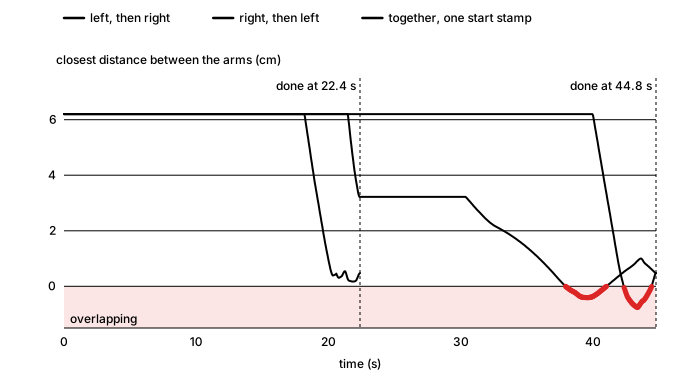
A two-arm plan is only safe if both arms run it together: it was checked with each arm where the other would be at the same instant. On hardware, though, mj_manipulator_ros, the lab's layer that runs those plans on the robot, ran multi-arm plans one arm after the other, which doubled the time and passed through states the planner never checked. Replaying the crossing plan that way in MuJoCo and checking every fourth of its states, the arms intersect in 97 of 1,400.

I rebuilt execution so every arm starts its trajectory on one shared start stamp: the trajectories must share their timestamps, one stamp a moment in the future is computed once, and each arm sends its goal from its own thread against that stamp, so the motors start together however long each goal takes to send. If any arm fails or is aborted, a shared event cancels the others mid-motion. Running two arms from two threads also meant making the shared code thread-safe: both threads stepped one MuJoCo model, and concurrent runs crashed until I serialized every access to it behind one lock. To bring it all up on the real robot safely, I built a hardware-in-the-loop bring-up protocol.

Line chart of the closest distance between the two arms over time for one crossing plan. Run left then right or right then left, it takes 44.8 seconds and dips below zero, the arms overlapping, near the end. Run together from one start stamp, it finishes at 22.4 seconds without overlapping
The same plan run the old way and together: how close the arms come, and when each run finishes.
Both arms moving at once on the robot, September 22.