← All skills

Skill

Real-time control

Control loops that must run on time, every time. 500 Hz arm control on OpenDubs, motors started on one shared timestamp, and odometry on ARUW's robot controller.

3 log entries2 projects

OpenDubsBest example

Arm control: three impedance controllers, then a simpler one

Cartesian controlJoint and null-space control

Also shows: Impedance controlC++ROS 2

Each arm is a 7-DOF OpenArm whose Damiao motors run their own impedance loop: the Thor sends position, velocity and torque targets with gains over CAN-FD, and each motor closes the loop itself. I measured the stock ROS 2 stack first. A goal is accepted in 2.55 ms, and with both arms holding one block, 47 ms passes between a command to one arm and the torque spike in the other (σ = 4.7 ms).

What I was after was axial compliance in Cartesian space: a gripper that holds firm along some axes and gives along others. I wrote three controllers with Pinocchio to get it (Cartesian, joint and null space). Pure Cartesian impedance gave that compliance, but it left the redundant elbow free to drift off the collision-checked path. The combined controller ran joint-space impedance and subtracted the Cartesian terms from it, keeping the axial compliance and control of the null space, but it was numerically unstable. The null-space controller worked, but I switched off it for the much lower latency of the motors' own impedance loops: in the end we gave up Cartesian compliance for speed.

What I settled on is simpler: the planned trajectory goes straight to the motors, plus gravity compensation at 500 Hz from Pinocchio's RNEA (the recursive Newton-Euler algorithm), with every goal checked against position and torque limits in both joint space and Cartesian space (through forward kinematics).
My Cartesian impedance controller on the robot: gravity compensation only (June 26), stiff in x and y but compliant in z and rotation, and stiff in x and y but compliant in rotation.
The four controllers in MuJoCo, built unchanged from their repos (faint arm: the plan). On the reaches the motors' own loop stays within about 2 cm of the plan while the others trail by 7 to 18 cm; near the straight arm the Cartesian one stays folded once pushed. Demo gains.

OpenDubs

Running both arms at once

Bimanual refactor

Also shows: PythonROS 2Motion planning

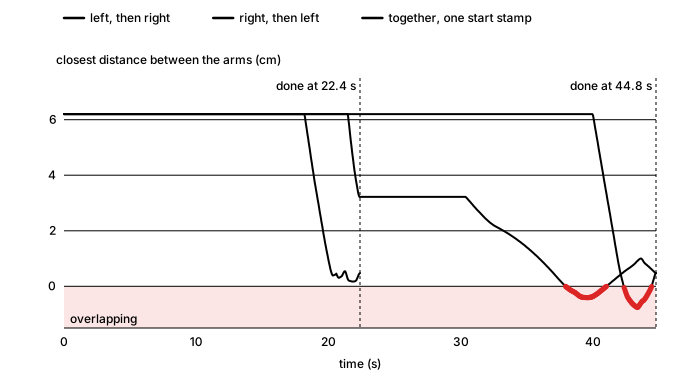
A two-arm plan is only safe if both arms run it together: it was checked with each arm where the other would be at the same instant. On hardware, though, mj_manipulator_ros, the lab's layer that runs those plans on the robot, ran multi-arm plans one arm after the other, which doubled the time and passed through states the planner never checked. Replaying the crossing plan that way in MuJoCo and checking every fourth of its states, the arms intersect in 97 of 1,400.

I rebuilt execution so every arm starts its trajectory on one shared start stamp: the trajectories must share their timestamps, one stamp a moment in the future is computed once, and each arm sends its goal from its own thread against that stamp, so the motors start together however long each goal takes to send. If any arm fails or is aborted, a shared event cancels the others mid-motion. Running two arms from two threads also meant making the shared code thread-safe: both threads stepped one MuJoCo model, and concurrent runs crashed until I serialized every access to it behind one lock. To bring it all up on the real robot safely, I built a hardware-in-the-loop bring-up protocol.

Line chart of the closest distance between the two arms over time for one crossing plan. Run left then right or right then left, it takes 44.8 seconds and dips below zero, the arms overlapping, near the end. Run together from one start stamp, it finishes at 22.4 seconds without overlapping
The same plan run the old way and together: how close the arms come, and when each run finishes.
Both arms moving at once on the robot, September 22.

Advanced Robotics at UW

Kalman-filter odometry for three dead wheels

8-state filterSplit filters

Also shows: State estimationC++

Our robots know where they are from dead wheels: small unpowered tracking wheels with encoders that roll along the floor. When the engineer robot moved to new odometry pods with three of them, I rewrote the team's Kalman-filter odometry for them; I had taught myself Kalman filters from Kalman Filter from the Ground Up. The first version was one 8-state filter fusing the three wheels with the IMU. Its covariance between heading and the x and y motion turned out to be negligible, so I split it into three independent two-state filters, for x, y and heading, each updated by one measurement: every step now multiplies 2×2 matrices and divides by a number, instead of working through 8×8 matrices and inverting a 7×7 one, and the wheels alone turned out to be enough without the IMU. To tune it, I drove fixed paths (straight forward, straight sideways, spins and a square), logged the raw wheels, and replayed them offline to fit each pod's position, angle and wheel radius and the filter's noise, checking the result against the IMU's heading. Our target was under 10 cm of error over the engineer's path, the most our vision system could correct for, and the tuned odometry met it.

The engineer driving itself at competition, from the third cube pickup to its drop-off: the filter's own logged pose, replayed at real time from just before it moves.
Tuning offline: a logged 5 m sideways push, replayed through the filter as the pods move from their design values to the tuned ones. With one pod 2.7° off straight, the design values read the push as a 79° turn; tuned, it comes to 4.99 m and follows the path the IMU's heading gives, ending within 1° of it.