AchillesBest example
V3: designing for performance
- Code I wrote
- 9,272 lines
- Language
- C++20
- Tools
- CMake, GoogleTest
- Hardware
- Laptop
- Role
- Solo
- Status
- Built
Also shows: C++Performance & SIMD
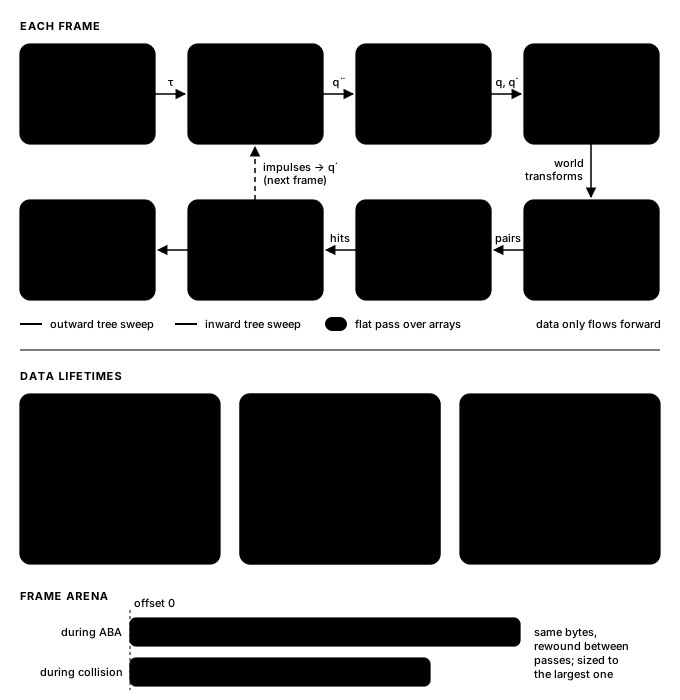
For V3, I wrote a full design document before writing any code. The target was concrete: simulate my club's six-robot arena of holonomic turret robots fast enough to train RL policies on a laptop CPU, since we don't have much GPU compute. Training takes millions of steps, so throughput was the goal, and V3 doubled as a performance learning exercise. One rule drove most decisions: only costs paid every frame matter. Only joint state, plus the contact solver's last solution, persists between frames. Everything else is either static data built at load time or scratch memory rebuilt each step and reused between passes. That rule became three pieces: fields; small operations that declare exactly which fields they read and write; and traversals that apply those operations across the joint tree, all checked at compile time. What the compiler can't check, the engine checks as it starts, and CI runs death tests confirming that a bad setup, like a model that doesn't fit its layout or an overflowing arena, stops it with a clear message instead of quietly corrupting a run. I kept V2's physically meaningful types but moved them into the math rather than the structure, so adding collisions or rendering meant adding passes instead of rewiring classes.