← All skills

Skill

Trajectory generation

Turning a path into speeds and accelerations the robot can deliver. SKIDADDLE's look-ahead and precomputed speed limits, the LQR tracker's speed profile, and ArmGroup's 125 Hz retiming.

4 log entries3 projects

FIRST Tech ChallengeBest example

SKIDADDLE: a path follower that plans with physics

Code

Also shows: Motion planningJavaOpen source

SKIDADDLE is a path-following library for FTC robots, written in Java, that I built to fix inefficiencies in Road Runner, the usual FTC path library, and get better paths. It plans with a physics model of the robot, and I derived all of its math by hand, myself, without AI or earlier work to build on. A path, a cubic Bézier for autonomous or a Hermite spline built on the fly in tele-op, is flattened into straight segments by adaptive De Casteljau subdivision, and a curve whose turns would need more than the robot's acceleration is relaxed until they don't. Every loop it splits the robot's velocity into a convergent part, toward the goal, and a transverse part, everything else. It first spends its acceleration budget cancelling the transverse part, then speeds up the convergent part, so from any starting position or velocity the robot converges on the path. A look-ahead over the stopping distance sets the fastest speed for each corner, and the robot switches segments when its braking distance says it must. Heading is a separate controller, and the result goes through PIDF and feedforward to the four wheels. A simulator draws the field and graphs every step.
SKIDADDLE's own simulator following a cubic Bézier path, in real time.
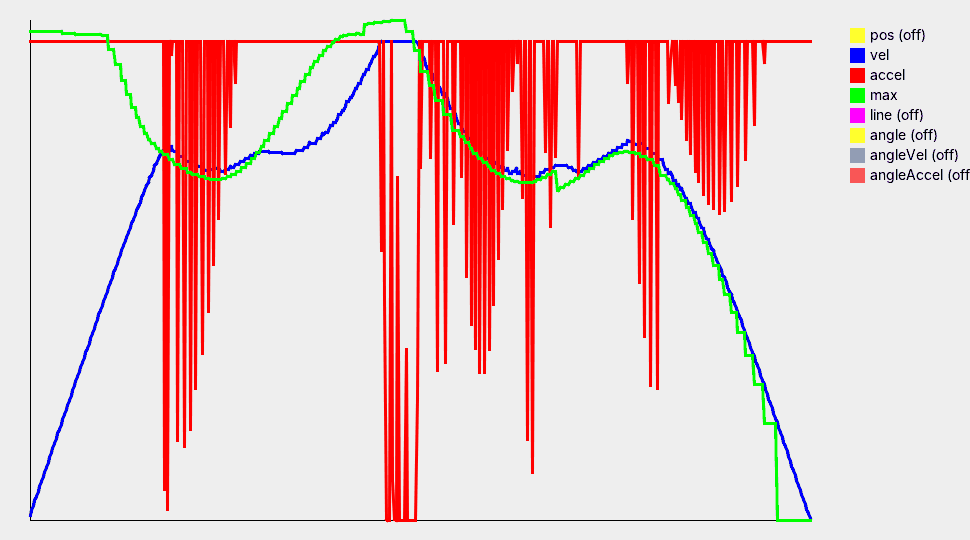
Line chart over the run: blue speed rises, follows the green speed limit through the turns and falls to zero at the end; the red acceleration sits at its cap and drops whenever the speed reaches the limit
The simulator's graph of the same run: speed (blue) tracking the look-ahead's speed limit (green), acceleration (red) mostly at its cap.

Advanced Robotics at UW

Path tracking: from pure pursuit to LQR

CodeThe LQR study

Also shows: Control systemsTechnical leadershipC++

Our chassis followed paths with pure pursuit: aim at a point a fixed distance down the path and ramp the speed up toward it. The robot's accelerations stay implicit in that, so it has no idea how hard it can brake or how fast it can take a corner, and at speed it swings wide of turns and overshoots where it should stop. I proposed replacing it with path tracking that models those accelerations explicitly, and led the feature from idea to implementation: I wrote the design and gathered the resources behind it, from spline fitting and arc-length reparametrization to the Riccati equation and a study that found LQR tracks more accurately than pure pursuit. First, a cubic spline through the waypoints is reparametrized by arc length, the speed at each point is capped by its curvature, and a forward and a backward pass keep every speed-up and every stop within what the robot can deliver. Then an LQR tracks that profile on a world-frame model of the chassis, where its dynamics stay constant, and its force is rotated into the robot's frame. I designed it and built the framework; the comparison here runs the finished MVP against our pure pursuit in simulation.

The same slalom, the same simulated chassis and the same 2 m/s top speed: LQR (blue) against the team's pure pursuit (orange), in real time.
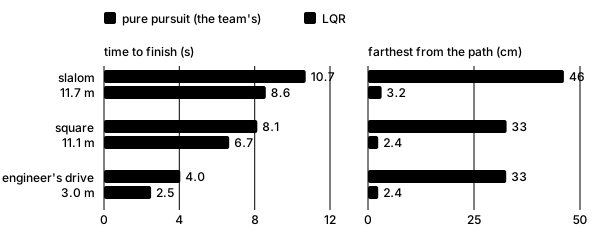
Bar charts for three paths: LQR finishes each sooner and stays within about 3 cm of the path, against 33 to 46 cm for pure pursuit
Three paths: LQR finishes 1.5 to 2.1 s sooner and stays within 3.2 cm of the path; pure pursuit strays up to 46 cm.

FIRST Tech Challenge

Reworking SKIDADDLE's control

Code

Also shows: Motion planningJava

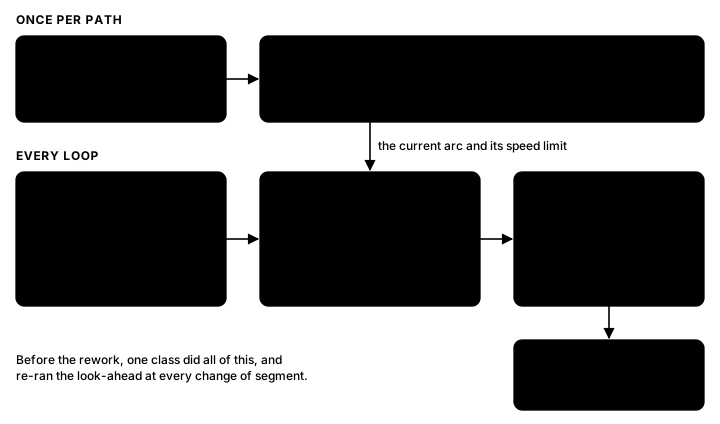
Over winter break I took SKIDADDLE apart into pieces that each do one job. Controllers now only ask for accelerations: one along the path, one back onto it, one for heading, each with a weight and a priority. A scheduler runs whichever are active, and a default controller brings the robot to a stop when none are. A new allocator turns the requests into motor space and hands out each motor's remaining headroom, highest priority first and shared by weight within a priority, so correcting off the path can come before speeding along it without any motor going past its limits. The look-ahead, before the most expensive part of the loop, became a precompute: when a path is made, one backward pass finds the fastest speed the robot can enter each turn at, so the loop only reads it.

Diagram: once per path, a path generator feeds precomputed speed limits; every loop, controllers send requests to a scheduler, which feeds an allocator that drives the wheels
The follower after the rework.

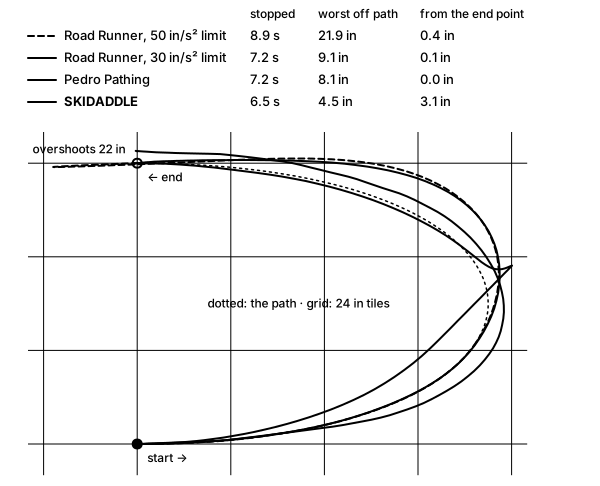
Planning in motor space means a turn's sideways acceleration comes out of the same wheel budget as speeding up and slowing down. Road Runner limits acceleration only along the path, so on a tight hairpin at the same limits its plan asks for more grip than the wheels have, falls behind and overshoots the end. With its limit lowered to 30 in/s² it stays within 9 in; SKIDADDLE stays within 4.5 in and stops 0.7 s sooner. It isn't ahead everywhere: on sharp corners Road Runner with the lower limit tracks tighter, and the rework doesn't correct sideways error yet, so it can stop a few inches off the end point.

Four runs around the same hairpin. Road Runner at the shared 50 in/s² limit falls behind in the curve and overshoots the end by 22 in. With its limit lowered to 30 it strays 9.1 in and stops after 7.2 s. Pedro Pathing strays 8.1 in and stops after 7.2 s. SKIDADDLE strays 4.5 in, stops after 6.5 s, and ends 3.1 in from the end point
Simulated: one mecanum robot model and the same speed and acceleration limits for all three. Road Runner 1.0.1 and Pedro Pathing 3.0.2 run from their source; SKIDADDLE's plan is followed with feedforward and a position term.

OpenDubs

N arms, one planner: ArmGroup

Pull request

Also shows: Motion planningPythonSimulation (MuJoCo)

The lab plans with its own MuJoCo planning library, mj_manipulator, which planned one arm at a time. With two arms on one torso, two plans that are each safe can still hit each other. I added an ArmGroup to it that plans all arms' joints together, so every step is checked arm against arm. On the clip's goals, the two arms planned separately collide in 58 of 210 frames; ArmGroup's plan bends one gripper about 16 cm around the other and touches in none. The same group plans to joint goals, gripper poses and lockstep Cartesian paths, keeps 5 mm between all geometry, retimes the trajectory at 125 Hz, and re-checks it at every sample. I made single-arm planning a one-arm group, and ArmGroup is what plans both arms on the robot today.

The same goals, each arm planned on its own (left, red while they intersect) and planned together by ArmGroup (right). The lines are the grippers' paths. MuJoCo, real time.
A two-arm handover planned with ArmGroup in MuJoCo (the can is carried kinematically).