← All skills

Skill

Benchmarking

Measuring systems against each other fairly. Achilles against MuJoCo, four VLAs on a real robot, SKIDADDLE against Road Runner and Pedro Pathing, and LQR against pure pursuit.

5 log entries4 projects

AchillesBest example

Beating MuJoCo on throughput

Benchmark code

Also shows: Simulation (MuJoCo)Performance & SIMDC++

To see where V3 stood, I benchmarked it against MuJoCo 3.15 on the same arm scenes, converted from the same .arow files, at the same 2 ms step, single-threaded on my laptop (Intel Core Ultra 9 285H). Batched across SIMD lanes, Achilles steps a seven-link arm 3.3× faster than MuJoCo's best single-threaded mode, reaching 5.45 million robot-steps per second at 64 robots. In double precision, MuJoCo's own, Achilles is still 1.5–1.6× faster at most batch sizes, and its results match MuJoCo's to about one part in 10¹¹. The one loss is a single seven-link arm, where most SIMD lanes sit empty (0.97×).

Line chart of speed relative to MuJoCo by number of links. V2 with one robot falls from 1.1× at one link to 0.48× at eight. V3 with one robot is 2.8×, 2.1×, 1.6× and 0.97× at one, two, three and seven links. V3 with 64 robots batched is 2.7×, 2.6×, 3.0× and 3.3×.
Each version timed against MuJoCo on the same machine, in its own benchmark: V2 against MuJoCo 3.3 (no gravity, 1 ms step), V3 against MuJoCo 3.15 (2 ms step).
The same double pendulum in Achilles and MuJoCo, matching out to 8 seconds. Same scene and start, both RK4 at a 2 ms step.

Benchmarking VLAs for ARCHITECT

Designing the benchmark: what makes a VLA test fair

Task configs

Also shows: Experiment designRobot learning

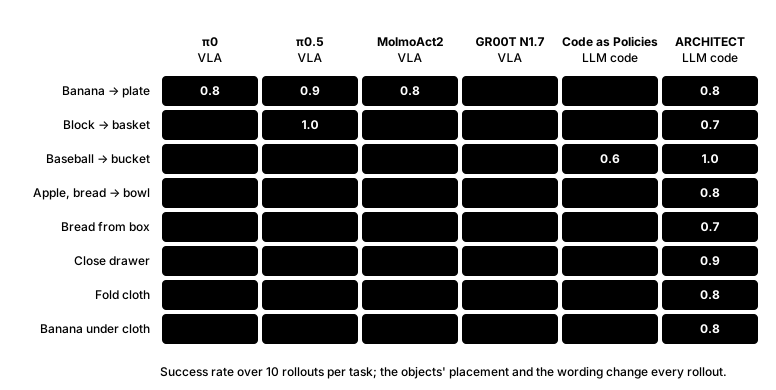
A VLA can look great near its training setup and fall apart a few centimeters away, so the hard part is deciding what a fair test is. We picked eight tasks across six kinds of challenge and changed the objects' placement and the wording on each of ten rollouts. We randomized the placements within a set workspace before running any evaluation, and every method ran the same ones. If I ran it again, the biggest thing I'd change is the lighting: we didn't control it well, and the models performed noticeably differently early in the morning than late at night.

Grid of success rates for eight tasks and six methods. The four VLAs score well only on simple pick and place, led by π0.5 at 0.9 and 1.0, and near zero on the drawer, the cloth fold and the banana under a cloth. Code as Policies peaks at 0.6. ARCHITECT scores 0.7 to 1.0 on every task
Success rate over 10 rollouts per task, from the paper's Tables 1 and 2.
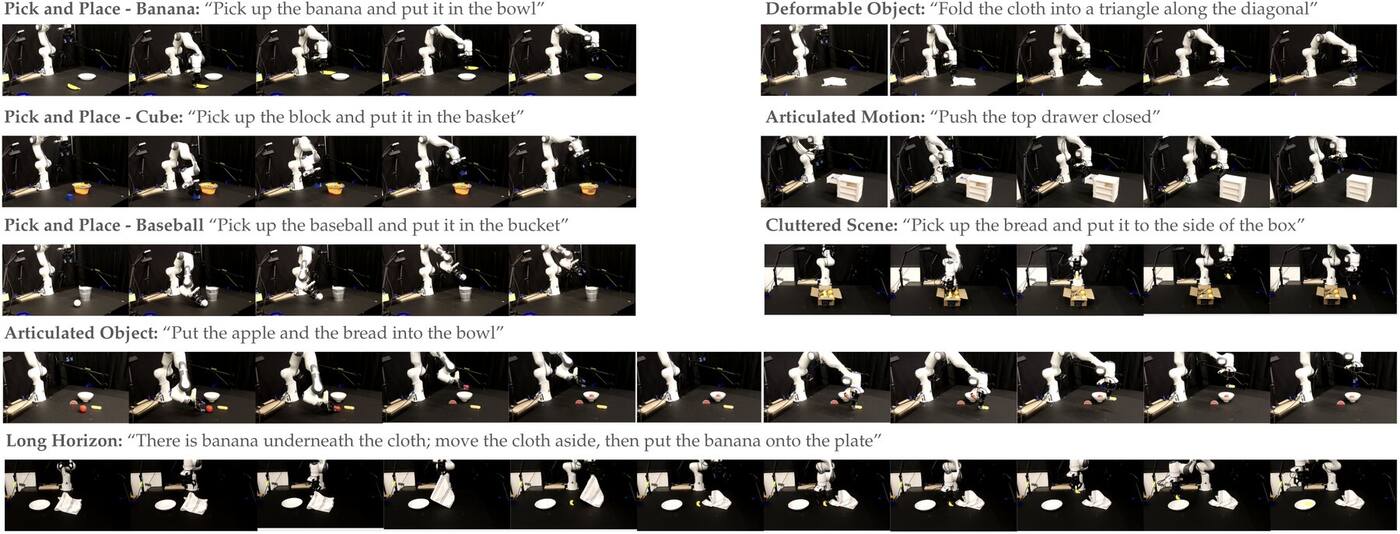
Filmstrips of the eight evaluation tasks on the Franka, each labeled with its challenge and instruction: three pick and place tasks, a two-object pick and place, picking bread from a cluttered box, closing a drawer, folding a cloth and uncovering a banana
The eight tasks, from the paper's Figure 3.

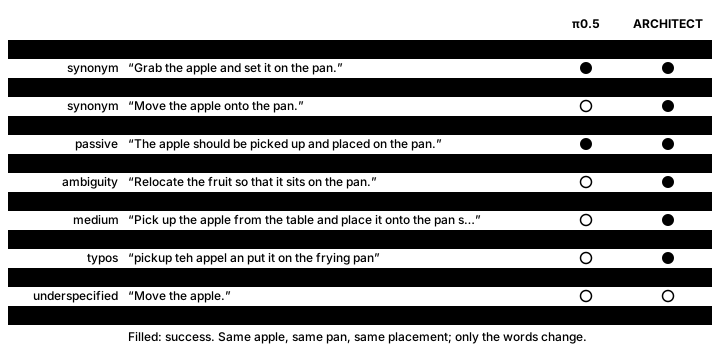
Success alone also hides a lot, so in the main benchmark each rollout was scored three ways: did it succeed, what fraction of the goals were met, and how far along a written rubric it got. Separately from that benchmark, we ran an ablation on wording alone: one task with the apple held still and only the instruction changed, fifteen phrasings run once each. π0.5 succeeded on "Grab the apple and set it on the pan" and failed on "Take the apple and place it onto the pan." It was sensitive to how specific the prompt was: given an underspecified one like "Put the apple away," the arm wandered without targeting the apple before eventually turning to the task, and an overly specified prompt degraded it the same way. It struggles when the task's intent is missing or buried.

MolmoAct2 was strong on the banana but struggled with the other pick-and-place tasks, which suggests it's fragile to object type, and on the harder tasks it often misread the prompt entirely, pressing the top of the cabinet instead of closing the drawer. It also disengaged early: in the two-object task it moved one object and withdrew, and in the cluttered box it picked the wrong object and never came back for the right one. Across all of it, the VLAs failed in the same few ways: sensitivity to how the prompt was worded, dependence on the object (π0 never got the baseball into the bucket), and poor spatial reasoning. They ignored vertical clearance, like the height of a barrier or how high to lift a cloth before setting it aside, and when a task called for a specific procedure they defaulted to another one that couldn't finish it, grabbing the drawer's lip instead of pushing it closed.

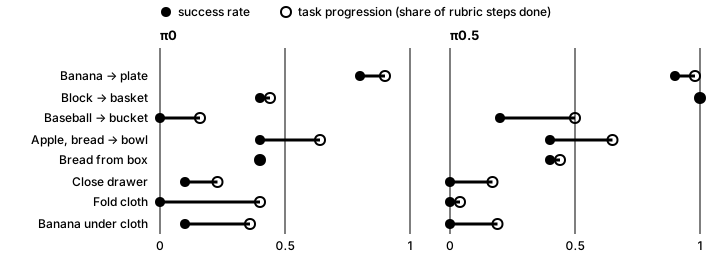
For π0 and π0.5 on each task, success rate beside task progression. On the hard tasks success is 0 to 0.1 while progression is often higher, such as π0 reaching 0.40 of the cloth fold
Why one number isn't enough: success against how far the policy got.
Fifteen phrasings of the same apple-to-pan instruction, with π0.5 and ARCHITECT marked for each. π0.5 succeeds on 6, failing on synonyms, reordered and ambiguous wording, typos and under- or over-specified instructions. ARCHITECT succeeds on 13
The language ablation: one task, fifteen phrasings, each run once.

Benchmarking VLAs for ARCHITECT

An evaluation harness for any VLA

Code

Also shows: PythonRobot learning

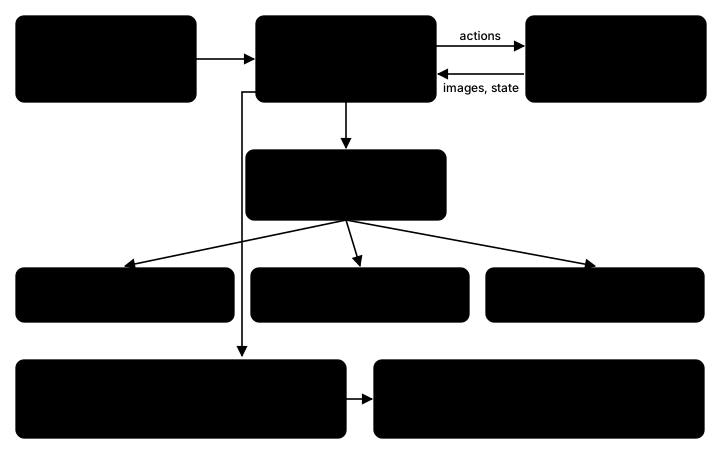
Every VLA ships its own server, and they don't agree on how to talk: openpi's π0 and π0.5 use WebSockets, GR00T uses ZMQ and MolmoAct2 uses HTTP. I wrote one harness that hides all of that behind a single interface: a new model, task or whole benchmark is a short YAML file, not new code.

On the robot, the harness asks the policy for a chunk of actions, runs eight of them open loop, then asks again, recording the scene and wrist cameras throughout. The operator scores each rollout, everything is saved as it goes so an interrupted run resumes, and one script turns the results into success rates per task and per prompt.

Diagram of the harness: YAML configs feed run_eval.py, which drives the DROID robot and asks one policy client for chunks of actions; the client reaches π0 and π0.5 over WebSocket, GR00T N1.7 over ZMQ and MolmoAct2 over HTTP; every rollout's scores and videos go to a results folder that compute_results.py turns into CSVs
How a run fits together.
π0.5 putting the banana on the plate.

FIRST Tech Challenge

Reworking SKIDADDLE's control

Code

Also shows: Motion planningJava

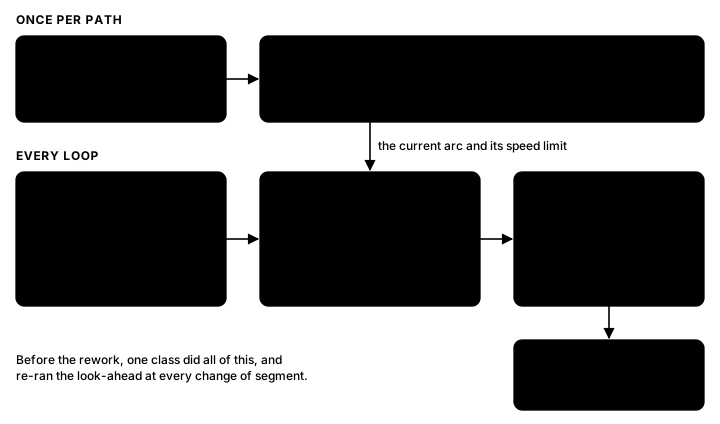
Over winter break I took SKIDADDLE apart into pieces that each do one job. Controllers now only ask for accelerations: one along the path, one back onto it, one for heading, each with a weight and a priority. A scheduler runs whichever are active, and a default controller brings the robot to a stop when none are. A new allocator turns the requests into motor space and hands out each motor's remaining headroom, highest priority first and shared by weight within a priority, so correcting off the path can come before speeding along it without any motor going past its limits. The look-ahead, before the most expensive part of the loop, became a precompute: when a path is made, one backward pass finds the fastest speed the robot can enter each turn at, so the loop only reads it.

Diagram: once per path, a path generator feeds precomputed speed limits; every loop, controllers send requests to a scheduler, which feeds an allocator that drives the wheels
The follower after the rework.

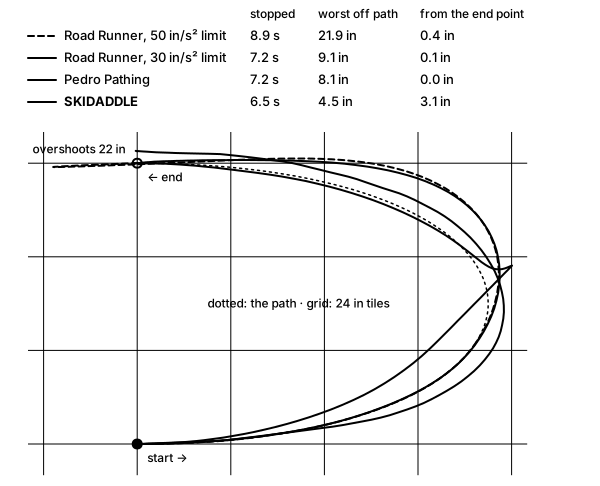
Planning in motor space means a turn's sideways acceleration comes out of the same wheel budget as speeding up and slowing down. Road Runner limits acceleration only along the path, so on a tight hairpin at the same limits its plan asks for more grip than the wheels have, falls behind and overshoots the end. With its limit lowered to 30 in/s² it stays within 9 in; SKIDADDLE stays within 4.5 in and stops 0.7 s sooner. It isn't ahead everywhere: on sharp corners Road Runner with the lower limit tracks tighter, and the rework doesn't correct sideways error yet, so it can stop a few inches off the end point.

Four runs around the same hairpin. Road Runner at the shared 50 in/s² limit falls behind in the curve and overshoots the end by 22 in. With its limit lowered to 30 it strays 9.1 in and stops after 7.2 s. Pedro Pathing strays 8.1 in and stops after 7.2 s. SKIDADDLE strays 4.5 in, stops after 6.5 s, and ends 3.1 in from the end point
Simulated: one mecanum robot model and the same speed and acceleration limits for all three. Road Runner 1.0.1 and Pedro Pathing 3.0.2 run from their source; SKIDADDLE's plan is followed with feedforward and a position term.

Advanced Robotics at UW

Path tracking: from pure pursuit to LQR

CodeThe LQR study

Also shows: Control systemsTechnical leadershipC++

Our chassis followed paths with pure pursuit: aim at a point a fixed distance down the path and ramp the speed up toward it. The robot's accelerations stay implicit in that, so it has no idea how hard it can brake or how fast it can take a corner, and at speed it swings wide of turns and overshoots where it should stop. I proposed replacing it with path tracking that models those accelerations explicitly, and led the feature from idea to implementation: I wrote the design and gathered the resources behind it, from spline fitting and arc-length reparametrization to the Riccati equation and a study that found LQR tracks more accurately than pure pursuit. First, a cubic spline through the waypoints is reparametrized by arc length, the speed at each point is capped by its curvature, and a forward and a backward pass keep every speed-up and every stop within what the robot can deliver. Then an LQR tracks that profile on a world-frame model of the chassis, where its dynamics stay constant, and its force is rotated into the robot's frame. I designed it and built the framework; the comparison here runs the finished MVP against our pure pursuit in simulation.

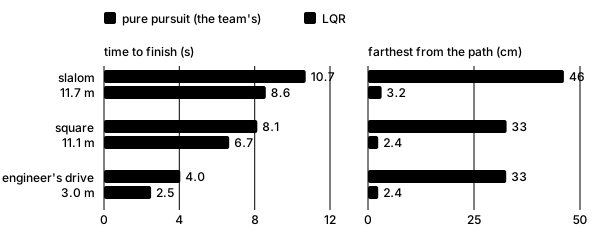
The same slalom, the same simulated chassis and the same 2 m/s top speed: LQR (blue) against the team's pure pursuit (orange), in real time.
Bar charts for three paths: LQR finishes each sooner and stays within about 3 cm of the path, against 33 to 46 cm for pure pursuit
Three paths: LQR finishes 1.5 to 2.1 s sooner and stays within 3.2 cm of the path; pure pursuit strays up to 46 cm.